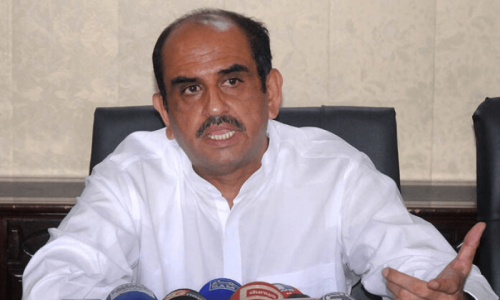
KP Chief Minister Ali Amin Gandapur’s support for the dead Kalabagh dam project has stirred up a storm. His endorsement of the dam runs contrary to popular public opinion not just in Sindh and Balochistan but also in his own province.
Ostensibly contingent on addressing provincial reservations to the controversial hydropower project on the Indus, his support for the dam — opposed by the provincial assemblies of Sindh, KP and Balochistan in the not so distant past — has baffled his own party as well. PTI leaders from KP and Sindh quickly disowned his statements. Asad Qaiser said that Mr Gandapur’s statement did not reflect the party’s policy. “The party has always made it clear that there should not be any controversial project. At the moment, there is a need to strengthen the federation,” he said. Haleem Adil Sheikh called the proposal a “dead horse”, which the PTI never supported. The PPP, through Nisar Khuhro, reminded Mr Gandapur that three provinces had already closed the door on Kalabagh.
The irony, however, is that the PML-N’s government in Punjab — often viewed by other federating units as the force behind the project — found itself in rare agreement with Mr Gandapur, with its information minister rushing to countersign the CM’s reckless grandstanding on behalf of her party. It exposes deep provincial fault lines: what is seen as a necessity in Punjab is viewed as a sell-out by the other provinces.
Mr Gandapur’s support for the Kalabagh dam comes on the heels of a plea from Prime Minister Shehbaz Sharif, during a recent visit to flood-hit Narowal district, for a consensus on new water reservoirs to fight the challenges of climate change and deal with the recurring floods.
While the move to bring up Kalabagh dam again risks opening old wounds, the cry for new reservoirs underpins how deeply our power elites are stuck in old, redundant concepts. As if we needed it, the effort to revive a defunct project is proof that our rulers are not capable of thinking beyond brick-and-mortar solutions to our worsening climate challenges. Is this because of lack of imagination or due to the massive money involved in such schemes, or both?
Pakistan, which is among the top 10 countries most vulnerable to the impact of climate change, desperately needs solutions to its problems of water shortages and droughts, devastating floods, erosion of the Indus delta, which is displacing local communities, and so on. These issues cannot be resolved by stopping the river flows through dams.
At a time when Pakistan needs unity more than ever, with floods wreaking devastation in several parts of the country and an economy on the brink, it is crucial that our rulers started to think beyond brick-and-mortar structures — if, indeed, they want to solve our increasing climate-related challenges.
Published in Dawn, September 4th, 2025