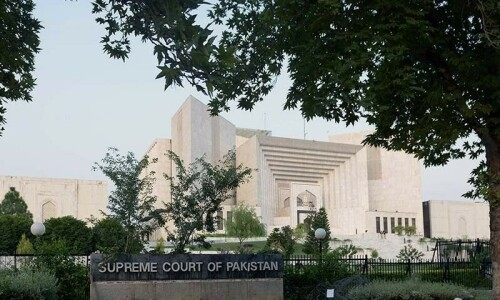
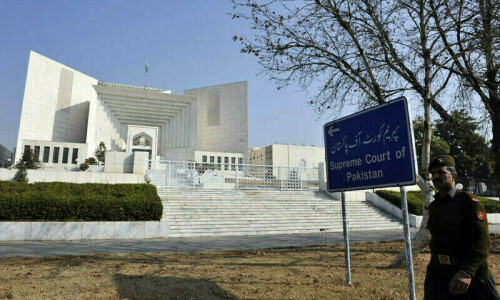
ISLAMABAD: As the scheduled full court meeting of the top court is fast approaching for giving a final approval to the Supreme Court Rules, the Supreme Court Bar Association (SCBA) has proposed open inquiries into complaints by the Supreme Judicial Council (SJC) against superior court judges.
In a set of proposals, the SCBA highlighted that open hearings will not only ensure internal accountability but also reaffirm the constitutional guarantee of equality before law under Article 25 and the right to fair trial under Article 10A of the Constitution.
Once a complaint is admitted, the SJC should conduct open proceedings subject to reasonable safeguards of dignity and decorum while deciding references within a fixed timeframe, preferably six months.
The 12-page set of proposals seeking to amend the SC Rules-2025 was furnished by SCBA President Mian Mohammad Rauf Atta and senior advocate Hafiz Ehsan Khokhar and were made known to the media at a press conference on Wednesday.
Set of proposals made public ahead of SC full court meeting
Considering the adverse reaction by the top lawyer’s bodies including the Pakistan Bar Council (PBC) and SCBA, Chief Justice of Pakistan (CJP) Yahya Afridi had constituted a committee under Rule 1(4) of the new rules to suggest recommendations for addressing any difficulty that may arise in giving effect to provisions of the new rules.
The proposals will be taken up by the full court on Sept 8.
The written proposals request immediate withdrawal of recent increase in court fees, setting up a timeline for lawyers representing different parties to present arguments, deciding every case filed in the Supreme Court within a year, issuing orders of court proceedings the same day and reserved decisions within a month.
According to the set of proposals, suggestions were made to ensure the implementation of legal provisions under Articles 4, 10A, 25, and 37(d) that guarantee equality before law, fair trial, and the right to inexpensive and expeditious justice.
It was noted that as SC’s sanctioned strength has been enhanced to 35 judges, including the CJP, this moment presents a unique opportunity for structural reforms.
The key reform proposals include rationalisation of court fees, stating the recent increase in court fees should be withdrawn to ensure inexpensive justice, as seen in Norway and Germany where only nominal fees were charged.
One of the proposals deals with the right of audience for counsel by ensuring uninterrupted opportunities for lawyers to present their case, similar to structured models in Norway, France and Germany, while another asked for increase in working hours and urgent benches of the court as practised in India, the UK and the US.
The right of access to justice enshrined in Articles 4 and 10A of the Constitution requires not merely the availability of judicial forums but also their effective and timely functioning, it was emphasised.
The pendency of cases before the SC that had reached unprecedented levels demands innovative approaches to maximise court’s productivity. One effective reform would be the extension of working hours for hearings and the creation of “late benches” dedicated to urgent matters such as bail, human rights petitions, election disputes and stay applications. Comparative practices illustrate that this model has proven highly effective in other jurisdictions, the proposal said, adding the Supreme Court of India regularly constitutes vacation benches and late benches to address urgent relief during recess and after-hours sittings.
For Pakistan, the adoption of extended hours and urgent benches would not only address the backlog but also reinforce public confidence in the judiciary’s responsiveness, thereby fulfilling the constitutional promise that justice will be administered without delay or denial.
Another proposal stated the Articles 175 and 184 envisioned the Supreme Court as the apex judicial authority, with mandate to adjudicate matters of constitutional, tax, civil, criminal, and regulatory importance.
On cause list and adjournment of cases, the proposal asked for adopting India’s continuous listing and China’s AI-driven scheduling to curb adjournments.
It asked for the issuance of short orders the same day followed by detailed reasons, consistent with the practice in Germany, Turkiye, and France.
About digitisation, it asked for e-filing, online tracking, and automation modelled on systems in Singapore, China, and Norway.
Published in Dawn, September 4th, 2025