• AGP report finds Rs507bn scheme plagued by tunnel collapses, delays and cost overruns
• Flagship project falls short on water rights, power output
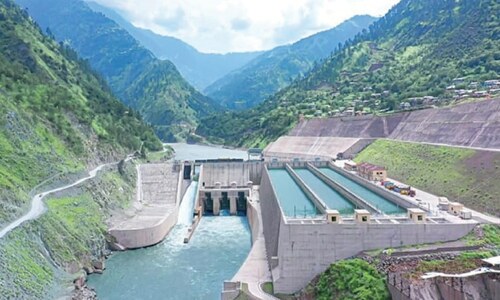
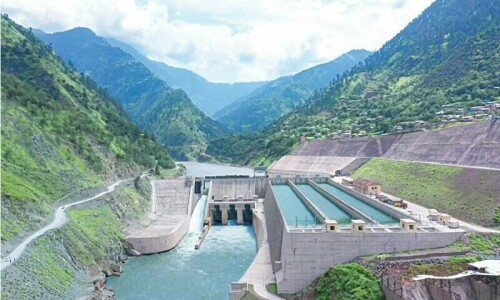
ISLAMABAD: The Auditor General of Pakistan (AGP) has declared the Rs507 billion Neelum-Jhelum Hydropower Project a failure in terms of objectives, planning and execution, saying it neither secured Pakistan’s water rights nor delivered the designed energy output, as its multiple tunnel faults and collapses have raised serious questions about the quality of work on a project of national importance.
In its performance audit report for 2022-23, submitted to the president and parliament, the AGP noted that the findings did not even include the major collapse of the headrace tunnel last year, which has kept the project shut. The report was finalised based on responses from Wapda’s management to audit objections.
According to the report, the project faced considerable delays despite the provision of tunnel boring machines (TBMs) meant to speed up excavation, mainly due to design changes.
“The project could not reap envisaged benefits of generation of planned electricity, establishment of water rights over Neelum River, selling of carbon credits under CDM, and completion of mitigation measures to safeguard the environment,” the AGP said.
Although the first unit was commissioned in 2018, contractors failed to complete pending punch list items, fulfil contractual obligations, or supply spare parts needed for smooth operation. “The major collapse in the tailrace tunnel (TRT) of the powerhouse just a few years after construction also casts doubt on the quality of design and works,” it added.
The report recalled that Wapda was to execute the project in line with the original PC-I, approved by the Executive Committee of the National Economic Council (Ecnec) in December 1989 at a cost of Rs15.012bn. After three intermediate revisions, Ecnec approved the fourth revised PC-I in May 2018 at Rs506.808bn, against which Rs423.446bn had been spent up to June 2023.
The project was delayed by almost eight years, raising its cost from Rs84.502bn (first revised PC-I) to Rs419.454bn, a cost overrun of Rs334.952bn. The AGP said the project was not executed efficiently as resources were poorly managed and timelines under PC-I were ignored. Contractual issues also remained unresolved due to contractors’ delays.
On its effectiveness, the audit concluded the project failed to deliver its objectives of cheap electricity and securing water rights over the Neelum River. The TRT collapse forced the powerhouse to remain shut until March 2023, leading to massive generation losses and worsening load shedding. “Neither the envisaged benefits of generating 5,150GWh annually were achieved nor water rights over the Neelum River established, particularly after Pakistan lost the Kishenganga case in the International Court of Arbitration,” the report noted.
The four generating units came online between July and December 2018. Funding was arranged through cash development loans from the federal government, Wapda’s own equity, the Neelum-Jhelum surcharge on electricity consumers, and local and foreign loans. The audit was conducted under INTOSAI Auditing Standards, Performance Audit Manual, and relevant rules.
Key audit findings included failure to generate the planned 5,150GWh annually, failure to establish water rights on the Neelum/Kishenganga, a nine-year time overrun, and a cost overrun of Rs338.944bn. Other serious lapses cited were an increase in the project’s payback period from five to 12 years, non-realisation of $50.133m in revenue under the Clean Development Mechanism, reduced annual generation, and environmental damage due to poor studies at the planning stage worth Rs3.05bn.
The report also highlighted Rs70.44bn in lost revenue due to non-approval of reference tariff by Nepra, Rs20.387bn in generation losses from the TRT collapse without inquiry, unjustified excess payment of Rs1.78bn to contractors without verifying raw stone aggregate quantities, non-recovery of costs for unexecuted telecom works and advance payments for an 11kV overhead line, undue benefits to contractors due to non-reinstatement of spoil deposits, non-indemnification of a Rs42bn insurance claim for the TRT collapse, and non-supply of spare parts and failure to execute punch list items by contractors.
The AGP concluded that the Neelum-Jhelum project fell short on nearly every planned objective, leaving behind massive financial losses, unresolved contractual disputes, and serious structural flaws.
Published in Dawn, September 3rd, 2025