When a road accident left Dr Saira Siddique paralysed, she was exposed to the shortcomings and fragmentation of Pakistan’s healthcare system.
Dr Siddique, who had worked in the US, wanted to send her medical records to her physician there for advice, but there were no Electronic Medical Records (EMR) to enable the data transfer. She required medical care for another 1.5 years, and in the absence of a hybrid healthcare platform where she could seek the doctor’s consultation from home, she was forced to spend six months recuperating at a hospital.
The experience prompted Dr Siddique, who was working with the government on a healthcare project at that time, to address these issues.
She founded MedIQ, a hybrid healthcare company which allows patients to get medical treatment at home or at any of the over 7,000 dispensaries and hospitals on the company’s panels.
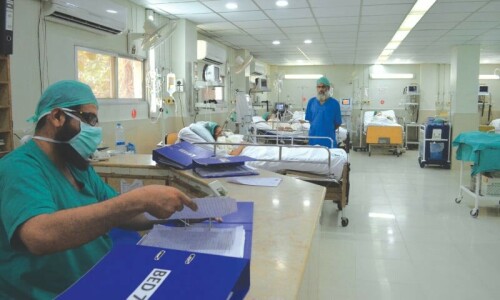
With thousands of medical centres on its panel, MedIQ uses digital interventions to provide quality healthcare
MedIQ has integrated all three components of the healthcare ecosystem, Dr Siddique told Dawn.
“MedIQ is a platform ecosystem connecting the patients, [healthcare] providers, and the payers,” she said.
Currently, the company operates in over 150 cities, primarily serving business-to-business and business-to-business-to-customer clients. The platform mostly serves companies and business entities, allowing them to offer reliable and affordable healthcare to their employees.
“The customer coming to us has already paid [for the service]. Either their company or insurer is integrated, or they have a subscription,” said Dr Siddique.
For its clients, MedIQ offers a fully digital platform to track the entire process — from consultations to payment.
A number of companies that use MedIQ’s platform for their employees’ healthcare services told Dawn the platform has enabled them to outsource the entire process of health insurance payouts.
Fahad Iqbal, an assistant manager at a Karachi-based software house that utilises MedIQ’s services, said his company previously had limited hospitals on its panel. With MedIQ’s network, that number has increased, making it convenient for employees to seek medical care at a place of their convenience.
The move to MedIQ also allowed the company to process its employees’ health-related claims and cut reimbursement duration from weeks to days, Mr Iqbal explained. “This has brought a sense of financial security to our employees who now know they won’t have to wait to get their money.”
Feroz Ali, an HR supervisor at an oil distribution company, said previously the company had an in-house team to manage health claims. Now, MedIQ takes care of the payment and bills the company for its services.
He said the feedback mechanism for doctors and physicians ensures a better quality of healthcare service for their employees.
Trust and reliability
As a physician herself, Dr Siddique was “never interested in practising medicine for individual patients”. She pursued her Master’s in public health from the London School of Hygiene & Tropical Medicine and a PhD in health economics.
Her experience working in health sectors in over five countries was the key reason she wanted to improve patients’ experience through the intervention of technology.
“We can’t focus on one thing. If we do, then the system will remain fragmented,” said Dr Siddique, explaining that only providing better quality healthcare was not enough.
She identified the need for two interventions: a centralised data system to digitally store health records for interoperability and sharing and a healthcare saving scheme which shields households from financial shocks in case of medical emergencies.
At MedIQ, healthcare data is stored in the form of EMR. This enables patients to access their medical records from any location, eliminating the need to carry physical records.
Dr Siddique explained that every hospital integrated with MedIQ uses technology for digital data collection.
For affordable healthcare, she stressed the need for mechanisms like closed-loop wallets, which can only be used for healthcare needs, and innovative payment models like Buy Now Pay Later.
“Around 40 per cent of our population lives below the poverty line, and for most of the remaining 60pc, a single emergency can send them below the poverty line. There should be certain products to help people save money for healthcare needs.”
The transparency enabled by these digital interventions, along with a robust review system for doctors and physicians on the platform, allowed MedIQ to build trust with its customers, which, according to Dr Siddique, is “the most important” thing in the healthcare business.
Funding and expansion
After establishing a presence in the Pakistani market, Dr Siddique expanded into the Gulf Cooperation Council (GCC) nations. However, unlike most investors, she didn’t move to Dubai and instead chose Saudi Arabia as MedIQ’s entry point into the Gulf.
For Dr Siddique, this was a logical decision, since Saudi Arabia — whose population is more than the combined population of the other five GCC nations — offers a bigger market than the United Arab Emirates.
She also believed the Saudi market was ripe for the arrival of a tech platform like MedIQ. “This is a place for players from other markets who have solutions. Since our product already had international credibility with all the accreditations and certifications, MedIQ’s adaptability to the Saudi market was easy,” she added.
Already present in two cities of Saudi Arabia, MedIQ raised $6 million for further expansion in the Kingdom. The funding came at a time when other Pakistani startups are struggling to raise funds. Last year, Pakistani startups attracted a cumulative funding of only $22.5m, down from the high of $347m in 2021.
Dr Siddique told Dawn she is in the process of raising more money to comply with regulatory requirements for expansion into other GCC nations.
Published in Dawn, The Business and Finance Weekly, September 1st, 2025