• Death toll in province reaches 365, as seven more bodies recovered in Swabi; floods hit Waziristan, Abbottabad, Tank
• Villages in flood-hit districts cut off due to landslides; bridges washed away in downpour
• Tarar says 25,000 people rescued in past two days, vows unified response to ‘national emergency’
• ISPR chief says nine units of military, paramilitary actively involved in KP, GB relief efforts
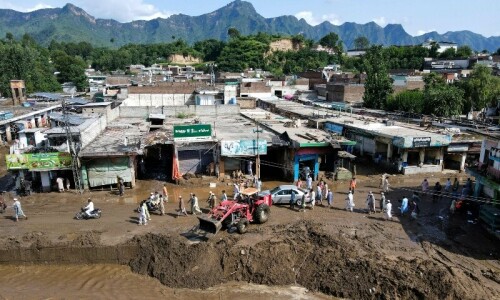
ISLAMABAD: As the government vowed to step up relief efforts in the flood-hit districts, Khyber Pakhtunkhwa continued to reel under the impact of torrential rains with more flash floods reported in several districts of the province.
KP Provincial Disaster Management Authority (PDMA) said the death toll since Friday had surged to 365, including 225 in the worst-affected Buner, while more than 180 people sustained injuries over the past several days.
On Tuesday, Upper and Lower South Waziristan districts fared the worst: one woman was killed in Upper South Waziristan. Upper South Waziristan’s Servekai subdivision was the hardest hit, where raging torrents washed away roads and bridges. The Tanga road was blocked due to landslides, while the Spalatoi, Bangashwala, and Madina Mor bridges collapsed due to the heavy flow, severing road links with remote villages.
Likewise, heavy rainfall triggered flash floods in the hill streams of Tank district and surrounding areas, sending powerful torrents into the city and submerging several localities. Officials said a flooded stream coming from South Waziristan reached Tank’s Garah Baloch village and submerged the city. The floodwater rose above the Garah Baloch bridge, forcing the closure of the Tank-Waziristan highway to all types of traffic. The main South Waziristan road was also blocked, disconnecting the road link between the two districts.
The floodwater also entered low-lying neighbourhoods, forcing the residents in the vulnerable areas to move to safer places amid a rise in the water level.
Though the district administration, along with rescue teams and heavy machinery, remained stationed at the Garah Baloch bridge to monitor the situation, the officials feared incessant rainfall could worsen the flooding and pose a greater danger to Tank’s urban and rural settlements.
In Abbottabad, the downpour damaged the Lora Nagri Bridge and cut off access to hundreds of villages. The bridge, a vital connection between Tehsil Lora and Rawalpindi and Abbottabad, partially collapsed, causing a complete halt in traffic. The central structure is reported to be sinking, further threatening its integrity.
Swabi toll surges to 24
In Swabi, the death toll in the Gadoon Amazi area surged to 24, including eight children, as the search for people swept away in flash floods continued on Tuesday. Rahim Jadoon, the Topi mayor, told Dawn that 23 people had been buried. Seven bodies were recovered on Tuesday.
Mr Jadoon, present in the affected area, said that as per the locals, about a dozen people were still buried under the rubble: “Over 12 houses collapsed in Dalori,” he confirmed.
As the entire village of Dalori and its surroundings were reeling from the shock, the locals could not even mourn their dead. “No one is in a position to hold a traditional three-day mourning period, as more and more bodies are being recovered,” locals said, adding, “We are in a complete state of pain and misery.”
In separate development rescuers have recovered the dead body of man who drowned in the Karnal Sher Khan’s area on Monday.
Rangaiz Khan, provincial minister for transport who was elected from the area, said that the district authorities did not have excavators, forcing the district administration and other departments to hire them from private contractors.
In Mansehra, rescuers, including volunteers and officials of Tehsil Municipal Administration and Rescue 1122, on Tuesday recovered another body from the flood-hit Haleem Bandi Neelband area of the district.
“A total of 20 men, women and children were swept away in the flood earlier this week, and now 18 bodies have been recovered. The search for the remaining two is still underway,” Mazhar Muzafar Awan, Baffa-Pakhal tehsil municipal officer, told reporters.
‘Unified response’
Separately, Information Minister Attaullah Tarar said the government was dealing with this “national emergency under a national response and all relevant departments, including the armed forces of Pakistan, are working in complete unison in this regard”, state-owned Radio Pakistan reported.
He was briefing the media persons along with Inter-Services Public Relations Director General Lieutenant General Ahmed Sharif Chaudhry and National Disaster Management Authority Chairman Lieutenant General Inam Haider Malik in Islamabad.
The minister said at least 25,000 people affected due to floods caused by torrential rains had been rescued since Aug 17 and moved to safer places, adding that almost 70 per cent of the electricity infrastructure damaged by floods had been restored.
The NDMA chief said bodies of many missing people, trapped under the rubble, had been retrieved, adding that the authority had already dispatched two relief convoys carrying relief goods to Swabi, Malakand and Buner, while another convoy would leave for Shangla.
‘Search and rescue, and flood relief operations’
The ISPR DG, as per Dawn.com, provided a summary of the efforts by the military in the northern areas in the wake of the monsoon rains. He said that KP received eight units of Infantry and Frontier Constabulary (FC), who were directly involved in search and rescue, and flood relief operations, while GB had one, taking the total to nine units.
He also said that one engineer brigade, two engineer battalions and two urban search and rescue teams were deployed in KP, while two engineer battalions were sent to GB, where they were “working on road opening and removing landslides”.
“Three medical units were deployed in KP, while nine medical camps were deployed in GB. More than 6,304 people have been treated.”
“In search and rescue operations, 6,903 people have been rescued,” he added.
Gen Chaudhry also said that one-day rations were allocated, amounting to 585 tonnes, adding that army aviation was deployed to oversee medical casualty evacuation, emergencies, and transportation of food and medicine.
He highlighted that multiple bridges and roads were repaired, while the telecommunication infrastructure in affected areas, including Shangla and Buner, was being repaired alongside the Pakistan Telecommunication Authority.
Speaking more specifically about affected regions, the DG ISPR said that the army deployed two battalions in Buner, two battalions in Shangla, one in Swat, one FC wing each in Bajaur and Dir, and one company in Swabi.
“These are dedicated resources … which were deployed 24 hours for flood relief rescue operations,” he said.
While speaking about logistics support, the DG said, “In Peshawar, there were 2,500 ready-to-eat meals and 20 tonnes of rations. In Nowshera, there are 5,000 ready-to-eat meals and 505 tonnes of rations,” he said, adding that they were being transported by road and helicopters.
He also highlighted that 90 roads were damaged in KP. Of those, nine roads were fully operational and 86 were partially restored, he added.
UNDP sends aid
On the other hand, the UNDP Pakistan said it was actively assessing needs on the ground to bridge immediate humanitarian gaps while also laying the groundwork for longer-term recovery and resilience as the crisis unfolds in the wake of floods across the country.
“Our hearts go out to the families who have lost loved ones, homes and livelihoods,” said UNDP Officer-in-Charge Van Nguyen in a statement issued in Islamabad.
UNDP has provided emergency relief items to assist flood-affected families in the hardest-hit regions of Khyber-Pakhtunkhwa. These supplies include 180 tents, 103 stretchers, 230 sleeping bags, 130 floodlights and 53 first aid kits, among other essentials.
Muqaddam Khan in Swabi, Nisar Ahmed Khan in Manshera, A.K. Wazir in South Waziristan Lower, Muhammad Irfan Mughal in Dera Ismail Khan and Rashid Javed in Abbottabad contributed to this report.
Published in Dawn, August 20th, 2025