ISLAMABAD: The Economic Coordination Committee (ECC) of the cabinet on Tuesday approved 100 per cent uniform electricity rates across the country, including Karachi, a subsidised fan replacement scheme, new energy vehicle policy 2025-30 and a Rs5.8 billion relief package for people affected by recent monsoon rains.
The ECC meeting presided over by Finance Minister Muhammad Aurangzeb also approved payment of Rs331m for settlement of international claims against the Pakistan National Shipping Corporation.
The power division told the ECC that the government had maintained uniform consumer-end power rates to the extent of base tariff and Quarterly Tariff Adjustments across the country.
However, the mechanism of charging Fuel Charges Adjustment (FCA) was currently not uniform for Discos and K-Electric. It sought application of Discos’ FCA for KE consumers as well to streamline subsidy payments through fresh policy directions to the National Electric Power Regulatory Authority (Nepra) for uniform FCA as well.
Approves uniform power tariff; unveils new energy vehicle policy, fan replacement scheme
The ECC also approved the term sheet jointly prepared by relevant stakeholders, including the National Energy Efficiency and Conservation Authority (NEECA), State Bank of Pakistan (SBP) and commercial banks, based on the Draft Tripartite Agreement for the launch of the Prime Minister’s Fan Replacement Programme.
To kickstart the programme, the ECC also approved a supplementary grant of Rs2bn to NEECA.
The programme will gradually replace 88 million (60pc) of the 147m old fans installed across the country. Over 10 years, the shift is projected to generate peak energy savings of 6,000-7,000MW and reduce capacity charges against the cooling load, which reaches 11,000MW during summer months.
Loans will be provided at the Karachi Interbank Offered Rate (Kibor) plus 2pc, with a 10pc first-loss government guarantee.
Repayments will be recovered via electricity bills using an on-bill financing mechanism implemented by distribution companies (Discos), K-Electric and the Power Information Technology Company (PITC).
Punjab IT Board (PITB) will manage digital onboarding using real-time data access provided by PITC. With an average net replacement cost of Rs10,500 per fan, payback periods will range from six to 18 months depending on the financing mode. The programme will initially target 22m consumers with compliant payment histories.
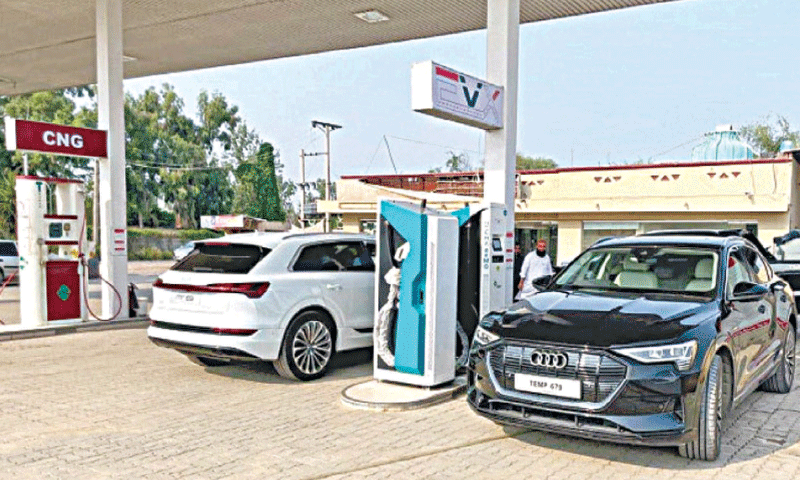
The ECC also approved New Energy Vehicle Policy 2025-30, claiming to be a forward-looking policy aligned with international best practices and the country’s transition towards electric vehicles.
The scheme involves up to 3pc tax on gross sales value of conventional local and imported vehicles for a five-year plan to roll out 116,000 electric bikes and 3,170 electric rickshaws or loaders, with an estimated cost of around Rs100bn.
The New Electric Vehicle Adoption Levy (NEVAL) has already been imposed through the budget 2025-26 to generate Rs122bn to finance the subsidy scheme with the approval of the International Monetary Fund (IMF).
A Rs9bn subsidy had already been earmarked for electric vehicles in the current year’s budget. To fund the scheme, the government imposed a 1pc NEVAL on local and imported vehicles up to 1,300cc, 2pc on vehicles between 1,300cc and 1,800cc and 3pc on vehicles above 1,800cc.
The first phase of the subsidy will involve the distribution of 40,000 e-bikes and 1,000 e-rickshaws/loaders. The scheme will be implemented across the country, including Azad Kashmir and Gilgit-Baltistan, with 219 e-bikes reserved for outstanding students. The second phase will roll out the remaining 76,000 e-bikes and 2,170 e-rickshaws/loaders.
The financing options will include both conventional and Islamic loans, with a maximum loan size of Rs200,000 for e-bikes and Rs880,000 for e-rickshaws/loaders. The markup rate will be set at six months Kibor plus 2.75pc, with loan tenures of two years for e-bikes and three years for e-rickshaws/loaders.
The government will provide a 20pc portfolio guarantee on a first-loss basis, while the debt-to-equity ratio will be 80:20. The government will contribute a maximum of Rs50,000 for an e-bike and Rs200,000 for an e-rickshaw/loader. Additionally, the government will cover the full cost of the markup, effectively making the loans interest-free for borrowers.
Published in Dawn, August 20th, 2025