NEW DELHI: Indian Prime Minister Narendra Modi will visit China later in August, his security chief said on Tuesday during talks with Beijing’s foreign minister in New Delhi.
Modi will attend the Shanghai Cooperation Organization (SCO) summit opening on August 31 in Tianjin, his first visit to China since 2018, Ajit Doval said in public comments at the start of a meeting with Beijing’s Foreign Minister Wang Yi.
“Our prime minister will be visiting for the SCO summit,” Doval said, speaking of “new energy” in diplomatic ties. Wang said China “attaches great importance” to Modi’s visit to the SCO summit, according to an official translator.
“History and reality prove once again that a healthy and stable China-India relationship serves the fundamental and long-term interests of both of our countries,” Wang added.
Beijing’s ‘mega dam’ on Yarlung Tsangpo River among points of concern for New Delhi
The Indian premier said late on Tuesday he was “glad to meet” Wang in New Delhi. “Since my meeting with President Xi (Jinping) in Kazan last year, India-China relations have made steady progress guided by respect for each other’s interests and sensitivities,” Modi said in a post on social media platform X.
“I look forward to our next meeting in Tianjin on the sidelines of the SCO Summit,” he said.
“Stable, predictable, constructive ties between India and China will contribute significantly to regional as well as global peace and prosperity.”
India also raised concerns with Wang about the construction of a mega-dam on a river that runs through Tibet and India and the effect it could have on downstream states, India’s foreign ministry said in a statement.
“The need for utmost transparency in this regard was strongly underlined,” it said.
Beijing approved the project in December on the river — known as Yarlung Tsangpo in Tibet and Brahmaputra in India — linking it to China’s carbon neutrality targets and economic goals in the Tibet region.
Once built, the dam could dwarf the record-breaking Three Gorges Dam on the Yangtze River in central China - and have a potentially serious impact on millions of people downstream in India and Bangladesh.
India and China, the world’s two most populous nations, are intense rivals competing for influence across South Asia and fought a deadly border clash in 2020.
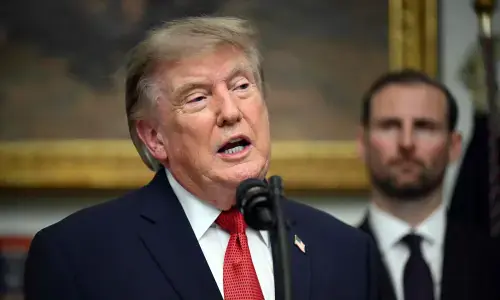
India is also part of the Quad security alliance with the United States, Australia and Japan, which is seen as a counter to China. However, caught in global trade and geopolitical turbulence triggered by US President Donald Trump’s tariff war, they have moved to mend ties.
Wang said during talks on Monday with Subrahmanyam Jaishankar, India’s foreign minister, the two countries should “view each other as partners and opportunities, rather than adversaries or threats”.
According to the BBC, the visit to India was “expected to lay the groundwork for Modi’s first visit to China in seven years later this month”.
It quoted Wang as saying that India and China should view each other as “partners” rather than “adversaries or threats”.
The rapprochement between the countries comes in the backdrop of India’s worsening bilateral relationship with the US.
Earlier this month, US President Donald Trump imposed an additional 25% penalty on Indian imports for buying oil and weapons from Russia, taking total tariffs to 50% - the highest in Asia.
On Monday, White House Trade Adviser Peter Navarro wrote a piece in The Financial Times, accusing India of “cosying up to both Russia and China”. “India acts as a global clearinghouse for Russian oil, converting embargoed crude into high-value exports while giving Moscow the dollars it needs,” Navarro wrote.
Published in Dawn, August 20th, 2025