
It might be less well-known to the broader public that Wales played a complex role in the British imperial project, acting simultaneously as a colony subjugated by England and an active coloniser overseas.
‘Tigers and Dragons: India and Wales in Britain’ is an engaging exhibition on display in Swansea that fosters a new dialogue rooted in deep colonial history. It is visually striking, politically thought-provoking and intellectually stimulating.
Co-curated by Dr Zehra Jumabhoy, an art historian and lecturer at the University of Bristol, and Katy Freer, exhibitions officer at the Glynn Vivian Gallery, the extensive display revisits legacies of empire, migration and cultural erasure, especially from a Welsh perspective. It skillfully explores complex historical moments, revealing transnational narratives formed by conquest, theft and greed, offering enlightening insights into legacies that are paradoxically interconnected across continents.
The central concourse of the Glynn Vivian Gallery offers an ideal setting for From Land to Fire, a large-scale panoramic painting created through a live performance by Goa-based artist Nikhil Chopra. It is inspired by and a response to the old picturesque watercolours of gallery founder Richard Glynn Vivian. The work establishes a strong link between the steelworks of Port Talbot near Swansea and Tata Steel in India — two sites shaped by extractive industries and industrial gluttony.
Art from South Asia and Wales comes together to question empire, identity and memory in a powerful exhibition that examines colonial legacy and cultural resistance
That colonial viewpoint is further challenged by a historic image from Lala Deen Dayal, showing Lord and Lady Curzon triumphantly posing over slain tigers — a stark symbol of imperial dominance and the environmental destruction that accompanied it.
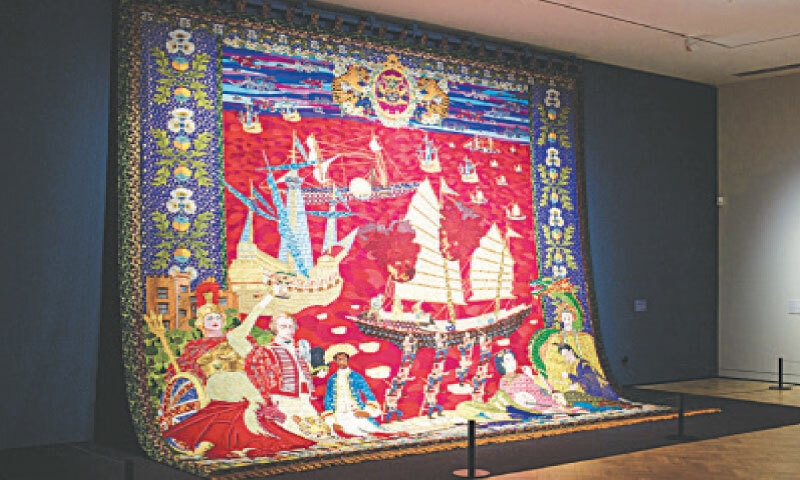
In the segment ‘Historical Encounters: Wales and India’, one of the exhibition’s most striking commissions, Adeela Suleman’s Imperium Amidst Opium Blossoms: A Kashidakari on the era of the East India Company, features a monumental tapestry. Under the guise of the East India Company (EIC), Britannia and Robert Clive stand before Powis Castle — a home for treasures looted from Tipu Sultan. Below are the Indian Tiger and the Red Welsh Dragon. In the background, warships wage the Opium Wars, while at the bottom, red poppies bleed into the sea, staining the water with blood: a testament to the human cost of imperial greed.
Besides Clive’s portrait, a colonial painting by Frank Nowlan depicts James Hill Johnes, Victoria Cross recipient, on horseback attacking enemies, exposing the violence and betrayal of British rule in India. Shahzia Sikander’s The Explosion of the Company Man offers a powerful counterpoint: a life-sized open book layered with Mughal, Chinese and British imagery that erupts into swirling fragments of rifles, scripts and symbols.
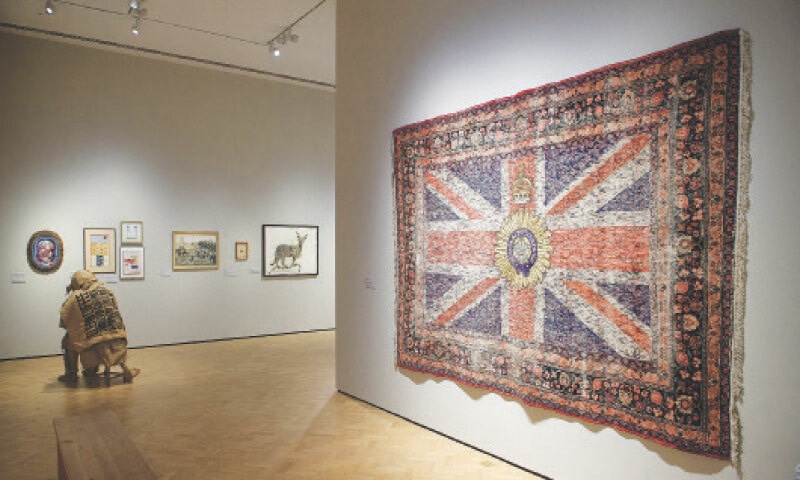
In a darkened space behind, her animation The Last Post follows an EIC figure through Mughal architecture and opium routes, dissolving into shards — a haunting metaphor for the collapse of empire. Conversely, in David Alesworth’s work, a Persian-influenced carpet appears frayed, but the colonial impression remains woven stringently to this day.
Daniel Trivedi, dressed as a tiger, haunts Powis Castle, evoking Tipu’s beast and colonial ghosts with his performance-based photographs. Surrounded and outlined with Urdu script, Muzzumil Ruheel’s headless tiger-skin trophy reflects colonial hunts — its silent form a relic of the empire’s violence and display. Another unusual sculpture, The Beast, by Laura Ford, depicts an emasculated and downtrodden lion — a fading patriarch whose power is waning.
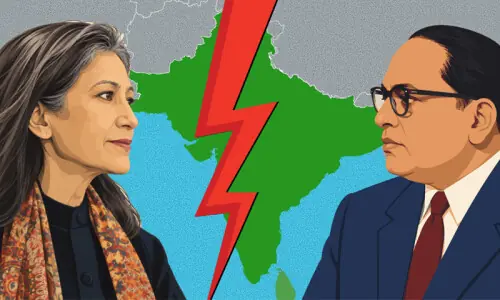
Reena Saini Kallat’s Hyphenated Lives (Ti-khor) merges declining tiger pride with emerging markhor symbolism — satirising how nations embed disappearing species into identity while erasing their habitats and histories. This powerful visual connects to other artists in a section called ‘Bridges and Borders’. Sir Cyril Radcliffe, a Welsh lawyer, was tasked with dividing India and Pakistan in 1947. One wishes he had known the unimaginably widespread violence and communal conflict his hastily drawn line would cause.
Liaqat Rasul’s double-panelled work reflects his Welsh-Punjabi identity and the enduring scars of the 1947 Partition. Vibrantly coloured, it captures Punjab’s energy while recalling how borders were blurred, dividing rivers, regions and regiments across India and Pakistan.
Zarina Hashmi’s various works explore migration, memory and displacement, shaped by her experience of Partition. She often uses maps and abstract forms to depict the idea of a home that is never fixed. Her work sits alongside Iwan Bala’s Tabernacl, both expressing a deep longing for an unreachable home. Anwar Jalal Shemza and Peter Finnemore also felt a persistent longing for home, despite belonging to many places simultaneously.
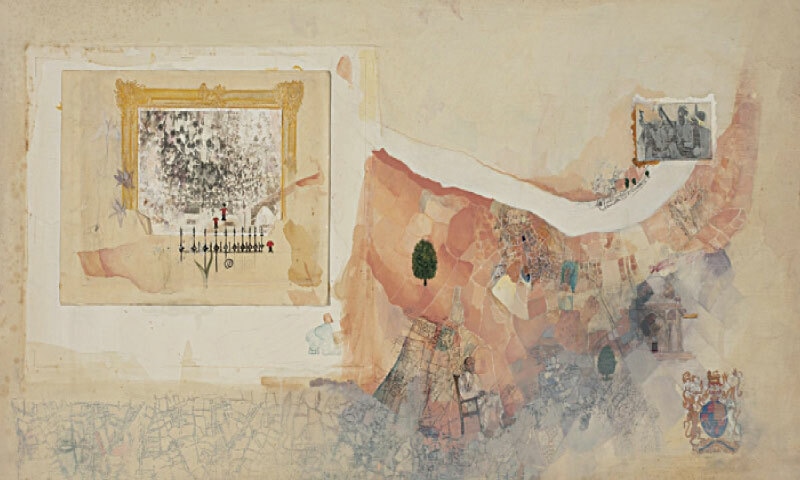
Another thought-provoking piece is Risham Syed’s Home, which combines a photograph of her grandfather, who was in the British Civil Service, with maps of Lahore and London, a colonial coat of arms and archival images, including a 1950s cricket team and an upside-down newspaper photograph of a violent event in Pakistan. This layered work reflects on how colonial legacies and personal identity remain intertwined. Nilima Sheikh’s work sits next to it and also shares a similar concern.
In Myths of Nation: Wo (Men) & Mothers, Pushpamala N. subversively reimagines ‘Mother India’, the goddess, alongside a map of the Indian Subcontinent (pre-Partition) to reveal how romanticised nationalism can marginalise and suppress dissent.
Similarly, Kathryn Campbell Dodd’s work references 19th century Welsh rioters who wore female disguises to demand justice. It underscores the danger of using the female form as a political tool — an anonymous, faceless costume for rebellion where a woman’s true identity is erased for the cause.
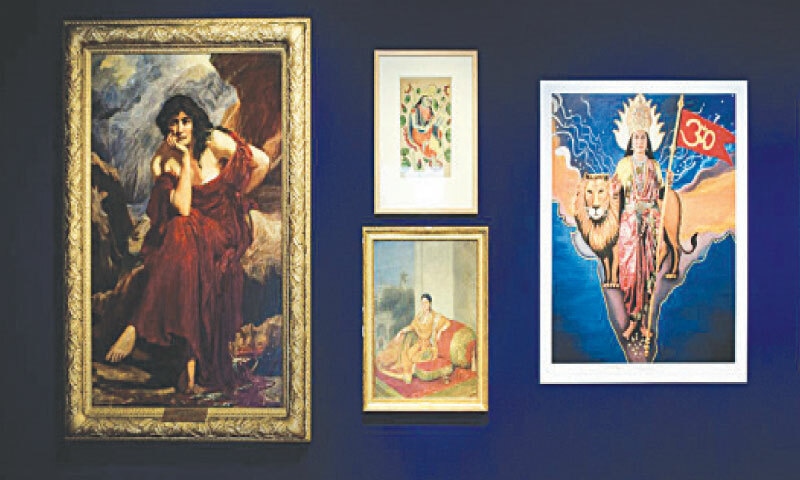
Paul Davies, founder of the Beca Group, presents his pivotal work, Mother Wales, which grounds the depiction of national trauma in a personal, authorial voice. The piece remains a powerful protest, employing the ‘ravaged’ female form to symbolise the suffering and cultural erosion of the Welsh nation under political oppression.
The painting illustrating the ancient Welsh myth of Blodeuwedd, a woman made of flowers by two magician men, is paired with Bushra Waqas Khan’s miniature dresses featuring motifs and patterns inspired by Pakistani affidavit stamp papers. This dialogue reveals a timeless, cross-cultural story of female identity shaped by external influences.
A powerful work by Nalini Malani employs ghostly figures with threaded knots on a loose canvas to depict a symbolic ‘mother’. She pays a quiet tribute to personal trauma and the unseen victims of history. Nations as mothers, argues Dr Jumabhoy, are highly problematic.
In the finale of this eye-opening exhibition, The Red Dragon, an ancient symbol of Welsh identity and its historic struggle against the English White Dragon, is re-examined by contemporary artists. Iwan Bala offers a critical perspective, depicting a boastful dragon that might have “forgotten his past” in his painting The Hare, The Mari, The Dragon.
Conversely, a community textile project led by Adeela Suleman has crafted a new, cross-cultural dragon. This collaborative creation suggests a more inclusive, globally connected identity for Wales, moving beyond its historic conflicts to embrace new narratives of belonging.
This exhibition offers a nuanced Welsh self-critique in the quest for decolonisation. Its diverse works invite us to face discomfort, grasp the significance of resistance, and ask: what follows empire? An apology, perhaps.
‘Tigers and Dragons: India and Wales in Britain’ is on display at Glynn Vivian Gallery in Swansea, England from May 23-November 2, 2025
The writer is an art critic who spends his time in Birmingham and Lahore. He can be reached at aarish.sardar@gmail.com
Published in Dawn, EOS, August 10th, 2025