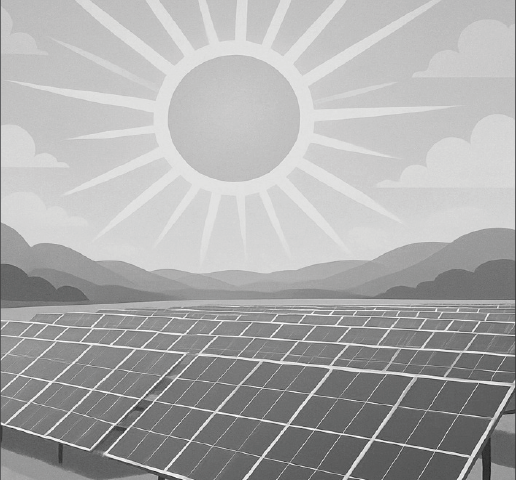
PAKISTAN recently joined the ‘25 per cent solar club’, with solar becoming the single largest contributor to grid electricity, surpassing gas, water and coal. Unlike the case in many countries, this momentum was gained not by any government invest-ment, but by the masses themselves, adopting rooftop and hybrid systems for their households, farms, shops and small businesses.
Solar systems have become primary or backup power source in off-grid rural areas and loadshedding-prone cities suffering from critical power outage exceeding 18 hours a day.
Every now and then, there is some move at various tiers of governance about taking steps to decelerate this rate of adoption. Such moves contradict the roadmap en-
visaged in the Alternative and Renewable Energy (ARE) policy, the National Climate Change policy as well as the official stance of the National Electric Power Regulatory Authority (Nepra) that promotes renewable energy access and market development.
Penalising clean energy while sub-sidising fossil fuels and excluding coal from the carbon levy conveys contradictory messages to investors and communities alike.
This actually indicates a planning catastrophe at a precarious time when issues like energy-poverty, circular debt and forex depletion demand cost-effective and scalable solutions.
Against this backdrop, the government of Sindh’s recent budget allocation of Rs25 billion for off-grid solarisation is a praiseworthy move. However, instead of merely targeting households, the government should focus on maximising the impact through prioritising investments in the domain of strategic decentralised solar solutions.
As things stand today, any negative move towards solarisation in the contemporary climate and economic settings is bound to be severely counterproductive. By taking the right policy decisions, the government can address the persistent challenge of the national power crisis.
Ashok Suthar
Tharparkar
Published in Dawn, August 6th, 2025