Race against time to rescue rock carvings


 0
0
YINCHUAN: Under the scorching sun, Xu Xiaolong and his colleagues trudged through wild grass in the Gobi Desert, scanning the rocky foothills of Helan Mountain in Yinchuan, Northwest China’s Ningxia Hui autonomous region, in search of ancient carvings.
Upon finding a pattern on a rock, the team immediately photographed and recorded its location.
“This field survey not only assesses the preservation status of previously discovered rock carvings but also helps identify and document new ones,” says Xu, 36, who works with the city’s Helan Mountain rock art administration. He explains that the work lays the groundwork for subsequent digital archiving and protection efforts.
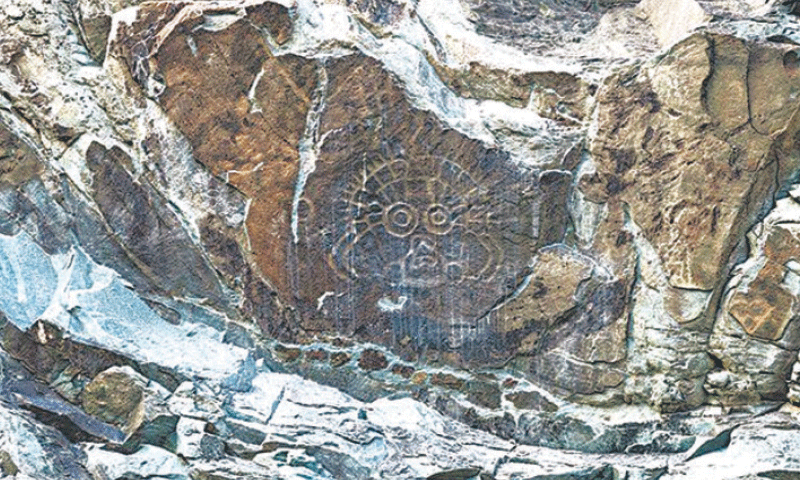
Stretching 250 kilometers, Helan Mountain is home to more than 20,000 ancient rock carvings created by early inhabitants with stones, metal tools or mineral pigments. Dating back approximately 10,000 to 3,000 years, the carvings depict diverse subjects ranging from natural images like human faces, animals and handprints, to ancient life scenes such as herding, hunting and rituals.
Launched in 2020 as a follow-up to the 2000-2003 census, the administration has surveyed over 12 sq km in and around the Helan Mountain rock art ruins park. The fieldwork is set to continue through the end of this year.
Among the carvings, one features two handprints — one large and the other small. “The handprints likely signify ‘me’ and ‘you’, carved into the rock to seal an agreement,” says Zhang Jianguo, deputy director of the administration.
He adds that affixing a handprint to documents such as deeds and contracts was a traditional practice in China, and this rock carving reflects that enduring cultural continuity.
Published in Dawn, August 4th, 2025