Hawkish Medvedev attempts to retain political relevance by invoking N-war
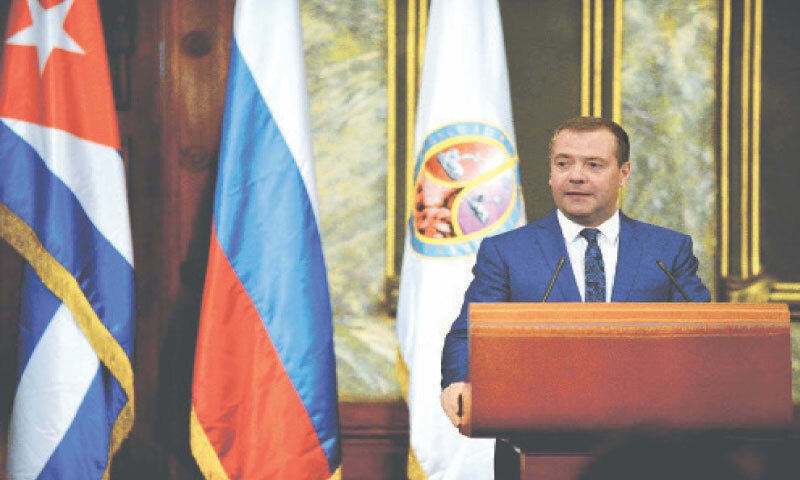

MOSCOW: Former Russian president Dmitry Medvedev, whose comments prompted US President Donald Trump to move two nuclear submarines, was once seen as a liberal reformer but has become one of the Kremlin’s most prominent anti-Western hawks.
The 59-year-old, who served as head of state between 2008 and 2012, sought “friendly” ties with Europe and the United States during his single term but faded into obscurity after handing the post back to President Vladimir Putin.
Demoted to prime minister in 2012 and then made deputy head of Russia’s security council in 2020 — a largely advisory role — Medvedev began espousing hardline views on social media shortly after Moscow launched its Ukraine offensive.
In public statements since the conflict began he has described Westerners as “bastards and degenerates”, declared that “Ukraine is, of course, Russia” and raised the possibility of using nuclear weapons against Russia’s enemies.
In June, after the US launched air strikes on nuclear facilities in Moscow-allied Iran, Medvedev suggested that “a number of countries” were willing to provide Tehran with nuclear warheads, prompting an angry Trump to accuse him of “casually” threatening a nuclear strike.
On Thursday, Medvedev alluded to Moscow’s semi-automatic “Dead Hand” nuclear arms control system in a Telegram post criticising Trump. Medvedev’s critics have derided his posts as an attempt to retain political relevance in Russia’s crowded elite circles, but Trump has taken the threats seriously.
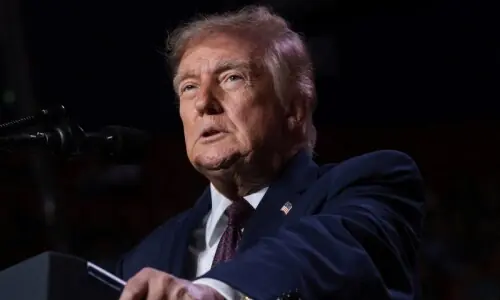
“Based on the highly provocative statements,” Trump said, “I have ordered two nuclear submarines to be positioned in the appropriate regions, just in case these foolish and inflammatory statements are more than just that.”
Tandem rule
Medvedev’s often incendiary posts contrast sharply with his public image in office, when he declared Russia did not want confrontation with “any country” as part of his foreign policy doctrine. In 2010, he signed a nuclear arms reduction treaty with US President Barack Obama, while in 2011 he brought Russia into the World Trade Organisation after 18 years of negotiations.
On his watch, Moscow also abstained in a key UN Security Council vote on Libya in 2011 that paved the way for a Nato-led military intervention, a decision Putin has relentlessly criticised since.
But it was always clear who was the senior partner in a pairing dubbed Batman and Robin by a secret US cable.
Medvedev’s first act after winning a 2008 presidential election on the back of Putin’s support was to appoint the Russian strongman as prime minister, giving Putin broad decision-making power.
While some in the West greeted Medvedev’s arrival, others saw him as simply a placeholder for Putin, who was able to circumvent constitutional term limits and remain in de facto power.
In 2008 Russia sent troops into Georgia, fracturing relations with the West, a decision that Medvedev insisted he made but that a top general claimed was planned by Putin before Medvedev was even inaugurated.
His trademark modernisation programme was marked by bold statements but was also mercilessly mocked by commentators for being short on actions as Putin held real power.
Putin’s protege
Medvedev, born in Putin’s home town of Leningrad, owes his entire political career to the former KGB agent. Putin took his protege to Moscow after being appointed prime minister in 1999 and Medvedev rapidly rose to become chairman of gas giant Gazprom. He also served as chief of staff at the Kremlin and as first deputy prime minister.
After taking office, he said Russia’s economy had reached a “dead end” and required urgent reform.
But cynics pointed out that such words counted for little when Russia was still dominated by Putin, and Medvedev himself played down the idea there was any radical difference in their visions.
After championing anti-corruption measures while in office, Medvedev was himself accused of graft in 2017, when late opposition leader Alexei Navalny alleged he had built a luxury property empire using embezzled funds.
Navalny was labelled an “extremist” by Russian authorities in 2021. While liberals and the West hoped Medvedev would reverse the increase in state control and erosion of civil liberties during Putin’s previous rule, he showed little desire for a radical break with Putin’s legacy.
“Vladimir Vladimirovich Putin really is modern Russia’s most popular, experienced and successful politician,” Medvedev said during an attempt to explain why he was standing down in favour of Putin in 2012.
Published in Dawn, August 3rd, 2025