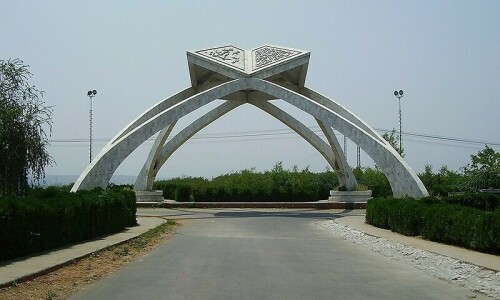
The Islamabad Police on Tuesday said that some students were “shifted” during an operation to vacate the hostels of Quaid-i-Azam University (QAU) that generated intense criticism.
Videos circulating on social media since the early hours of today showed police personnel outside the hostels with some of them about students being arrested or taken away. The videos elicited strong criticism with many decrying why action was being taken against students and saying that over 70 were arrested.
A statement from the Islamabad police confirmed the development, saying: “At the request of the university administration, [the] Islamabad police provided legal police assistance. The students had vacated 11 hostels, while regarding the remaining four hostels, the university administration stated that some students were not vacating them despite instructions from the university administration and were residing there illegally.
“Upon the written request of the Quaid-i-Azam University administration, assistance was provided to the university administration and security guards. Those students who resisted this peaceful process have been shifted from the hostel, and now legal action will be taken based on the written request of the university administration.”
A statement from the university said the district administration took action in the morning to vacate the hostels after the deadline expired.
“It should be noted that [the] Quaid-i-Azam University had decided to temporarily close the hostels from July 13, 2025, in view of the annual repair, maintenance and renovation work during the summer vacations. A large number of students complied with this decision and vacated the hostels, however, some students were still there who had been given repeated time by the university and the district administration to vacate the hostels,” it read.
It added that the Islamabad High Court had dismissed the students’ petition challenging the administrative action of the university as inadmissible and confirmed the autonomy of the institution under the Quaid-i-Azam University Act 1973.
“[The] Quaid-i-Azam University once again reiterates its commitment to providing a safe and conducive environment for students while maintaining discipline, academic standards, and institutional autonomy,” the statement said.
Contesting the police statement, human rights lawyer Imaan Zainab Mazari-Hazir in a post on X questioned why entry was not being allowed to the Secretariat police station. “We just had a meeting with the vice chancellor [of the QAU] and he clearly stated that he did not make any such request,” she added.
She alleged that over 70 students were “being kept in illegal detention without any first information report (FIR)” at the Secretariat police station and the authorities were “refusing to share copy of FIR”.
Former senator Afrasiab Khattak termed the police crackdown “shameful”.
“Forty students are arrested because they are requesting to be allowed to stay in hostels to prepare for their exams. They must be immediately released and the issues should be resolved by negotiations. Campuses are important part of civil society,” he wrote on X.
Academic and activist Dr Taimur Rehman said the students were protesting to start the summer semester. “Imagine. They were arrested because they want to study,” he said.
Artist, environmentalist and activist Zulfikar Ali Bhutto Junior lamented that “universities in Pakistan have turned against their own students”. “Seventy students from Quaid-i-Azam University have been arrested in Islamabad for simply requesting that hostels be kept open over the summer. Keep our students safe! Keep campuses safe!”
The incident was also strongly criticised by former human rights minister Dr Shireen Mazari in a series of posts on X.
In September, as many as 25 students were injured in a clash between two groups at the university. Of the injured students, 20 were admitted to Pakistan Institute of Medical Sciences and five to Polyclinic.
The university (once named Islamabad University) was established in July 1967 under an act of the National Assembly and started teaching and research programmes for PhD and MPhil degrees. Later, it also started offering master’s, graduate and undergraduate programmes.