0
0

ISLAMABAD: Speakers at a seminar on Monday paid tribute to the legendary and revolutionary poet Fahmida Riaz, describing her as a voice of resistance and literary brilliance.
She advocated for an egalitarian, progressive society to ensure social justice, inclusive development in Pakistan, they said.
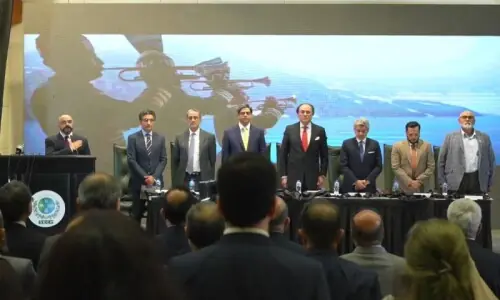
The Sustainable Development Policy Institute (SDPI), in collaboration with the Ahmed Salim Study Centre, organised the seminar. Prominent scholars, writers, poets and journalists reflected on her multifaceted contributions to literature, social justice and democratic ideals.
SDPI Executive Director Dr Abid Qaiyum Suleri said the initiative was part of the Ahmed Salim Study Centre’s ongoing efforts to uphold the legacy of progressive voices in Pakistan.
“Fahmida Riaz was not just a poet but a social critic whose works foreshadowed modern development benchmarks such as gender inclusion and freedom of expression,” he said.
He also underlined the relevance of Riaz’s work in the current context, especially in the wake of ongoing honour killings and other societal injustices.
Dr Suleri noted that decades ago Riaz had highlighted issues like women’s autonomy, honour-based violence and the repression of democratic freedoms, subjects still relevant today.
The session featured a visual and spoken-word display of Fahmida Riaz’s poetry, offering a deep insight into the revolutionary content of her work.
Dr Shafqat Munir, Deputy Executive Director of SDPI, spoke of how Riaz’s poetry provided moral and intellectual support to the National Students Federation (NSF) and other movements resisting Gen Ziaul Haq’s regime.
“She was a visionary, her ideals on gender equality and freedom of thought were once branded as taboo, but now they are recognised as essential development goals,” he stated.
Saleem Khilji, Editor Publications at SDPI, recounted the grim censorship Fahmida Riaz faced under Zia’s dictatorial rule.
“Her magazine Awaz was banned, and her reaction to Zulfikar Ali Bhutto’s execution, calling it a capital punishment for democracy, demonstrated her political insight and courage,” he said.
Mr Khilji also praised Dr Humera Ashfaq for reviving the legacy of the late Ahmed Salim.
Joining online, Amar Sindhu, noted author and assistant professor at Sindh University Jamshoro, called Fahmida Riaz “a soul forever tied to the land of Sindh,” lauding her consistent connection between her thoughts and actions.
“There was never a disconnect between what she believed, wrote and practiced,” Sindhu said.
“Her life in exile was among her most creative yet challenging phases. Her command over multiple languages, Hindi, Urdu, Persian and English, gave her poetry a unique linguistic depth,” she added.
Renowned historian and academic Prof Dr Syed Jaffar Ahmed described Riaz as “a multidimensional creator of resistance literature,” lamenting how today’s society has evolved into a one-dimensional entity with little space for such voices.
Published in Dawn, July 29th, 2025