BEIJING: Beijing issued on Saturday a warning for geological disasters including landslides and mudslides after intense rainfall the day before, with storms circulating China’s north unleashing for a second time a year’s rain on nearby Baoding.
The Beijing meteorological agency’s alert for 10 of the city’s 16 districts came as local authorities also warned of flash floods in mountainous areas.
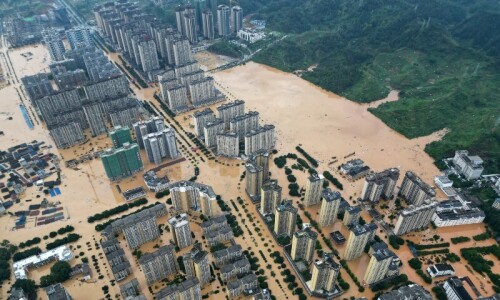
In neighbouring Hebei, extreme overnight rains in Fuping, a part of the industrial city of Baoding, saw records broken at a local weather station with 145 mm (5.7 inches) per hour of precipitation, state broadcaster CCTV said.
The Xizhuang station recorded a maximum rainfall of 540 mm over an eight-hour period, superseding Baoding’s average annual rainfall of about 500 mm. Just a day ago, storms dumped similar amounts of precipitation on Yi, another part of Baoding.
Beijing warns of geological disasters in China’s north
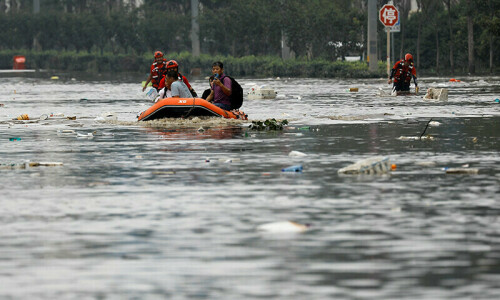
The rain held destructive power, CCTV said, affecting more than 46,000 people and forcing 4,655 of them to evacuate.
Northern China has witnessed record-breaking precipitation in recent years, exposing densely populated cities including Beijing to flood risks. Some scientists link the higher rainfall in China’s usually arid north to global warming.
China’s Water Resources Ministry has issued targeted warnings to 11 provinces and regions, including Beijing and Hebei, for floods arising from small and medium-sized rivers and gushing torrents from mountains.
The alert also sought to ensure that reservoirs and silt dams are safe during floods.
Across the country, heavy rainfall has caused 13 rivers scattered through seven provinces to swell past their flood warning levels by as much as 1.4 m (4.6 feet), CCTV reported, citing the ministry’s findings on Saturday morning.
Among them, one tributary of Inner Mongolia’s Dahei River and another of Shaanxi’s Yanhe River recorded their biggest floods since records began.
The storms are part of the broader pattern of extreme weather across China due to the East Asian monsoon, which has caused disruptions in the world’s second-largest economy.
In a separate bulletin, CCTV also said two small reservoirs in northeastern Jilin province were operating above the flood limit, as rivers continue to swell.
Local authorities have begun activating five large reservoirs to help with flood water discharge.
Extreme rainfall and severe flooding are highly monitored by Chinese authorities as they challenge the country’s ageing flood defences, threaten to displace millions, and wreak havoc on a $2.8 trillion agricultural sector.
Published in Dawn, July 27th, 2025