0
0

The Economic Coordination Committee (ECC) of the Cabinet on Friday approved Pakistan’s Green Taxonomy, as proposed by the Ministry of Climate Change and Environmental Coordination, in a “major step towards environmental sustainability”.
“The chair appreciated the initiative, noting that it was long overdue and would play a vital role in facilitating access to financing for green projects in the country,” a statement issued by the Finance Division read.
During a meeting of the Senate Standing Committee on Climate Change and Environmental Coordination in March, State Bank Governor Jameel Ahmad said the taxonomy will allow financial and non-financial companies to share a common definition of economic activities that can be considered environmentally sustainable.
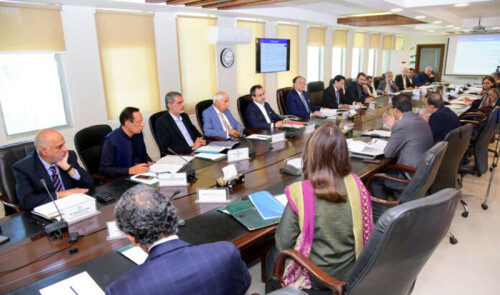
The statement issued today noted that the ECC meeting was held under the chairmanship of Finance Minister Muhammad Aurangzeb to deliberate on a range of important agenda items concerning industrial growth, environmental policy, skill development, housing finance, and telecommunications.
The meeting was attended by Federal Minister for Power Sardar Awais Ahmed Khan Leghari, Minister for Petroleum Ali Pervaiz Malik, Minister for Commerce Jam Kamal Khan, along with senior officials from relevant ministries, divisions, departments, and authorities.
It added that the ECC reviewed and endorsed a report presented by the Ministry of Commerce on industrial competitiveness and export-led growth of the steel sector, in alignment with the National Tariff Policy 2025–30, aimed at reducing production costs and enhancing export competitiveness.
The committee also approved a summary by the Ministry of Commerce for filing an appeal in the Supreme Court against the decision of the Lahore High Court regarding the grant of gas and Regasified Liquefied Natural Gas tariff concessions to Ghani Glass Limited. The Committee found the appeal untenable in light of the fact that concessionary energy tariffs for five export-oriented sectors have already been withdrawn and are no longer available to any sector.
To support skills development through outcomes-based financing, the ECC approved a government guarantee of Rs1 billion for the issuance of the Pakistan Skill Impact Bond (PSIB), as moved by the Ministry of Federal Education and Professional Training.
In the housing sector, the ECC approved a markup subsidy and risk-sharing scheme for affordable housing finance, with the objective of expanding access to low-cost housing.
The committee also urged the ministry to develop a comprehensive, integrated database of the housing sector in coordination with relevant federal and provincial stakeholders, in order to ensure better targeting and effective implementation of the scheme.
The ECC was briefed by the Ministry of Industries and Production on the status of availability and pricing trends in the vegetable ghee and oil market. While noting the ministry’s assurance regarding adequate national stock levels, the committee expressed concern over the limited pass-through of declining international prices to domestic consumers.
It advised vigilant monitoring to prevent price distortions and potential cartelisation and emphasised the need for active coordination with the Competition Commission of Pakistan, National Price Monitoring Committee (NPMC), and provincial governments through the Ministry of Industries and Production.
The ECC also approved a proposal by the Ministry of Information Technology and Telecommunication for the revision of charges for Radio-Based Services (RBS). The committee directed the ministry to ensure periodic revision of RBS charges every three to five years, aligned with ongoing economic changes and technological advancements in the sector.
Furthermore, the committee endorsed a revised composition of the advisory committee overseeing the release of IMT spectrum, which is critical for improving next-generation mobile broadband services in Pakistan.
In conclusion, the ECC approved the formal declaration of ship breaking and recycling as a recognised industry, as recommended by the Ministry of Maritime Affairs.
Last month, the government increased the price of gas by 50 per cent in an apparent move to meet the demand of the International Monetary Fund (IMF).
The ECC of the federal cabinet approved the hike in fixed gas charges for all consumers from July 1.
The committee instructed the ministry to coordinate with the Power Division and share relevant data on power consumption patterns in the sector, to enable an accurate assessment of the implications of applying industrial power tariffs in place of the existing commercial rates.