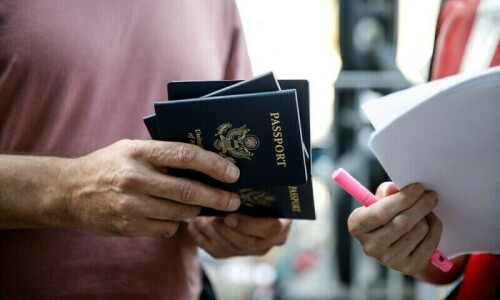
The United States will soon require international visitors to pay a “visa integrity fee” of at least $250, a new addition to existing visa application costs, according to a provision in the Trump administration’s recently enacted domestic policy bill, CNN reported on Tuesday.
In the fiscal year 2024, the US issued nearly 11 million non-immigrant visas according to the State Department. These encompass international students, many leisure and business travellers and other temporary visitors.
The new fee will apply to all visitors requiring non-immigrant visas to enter the US. This does not include tourists and business travellers from countries that are included in the Visa Waiver Programme — including Australia and many European countries — that do not need visas for stays of 90 days or less.
The fee is to be paid at the time visas are issued. Although there will be no fee waivers for the payment, the provision states that travellers who comply with the terms of their visa can have the fee reimbursed after their trip.
Houston-based Reddy Neumann Brown PC law firm’s immigration attorney, Steven A. Brown, said in a post, “The intent behind this refund provision is to incentivise compliance with US immigration laws by treating the $250 as a refundable security deposit — essentially rewarding those who follow the rules.”
However, he added that the refund is not automatic and that “the burden will likely fall on the visa holder to prove compliance” in an as-yet-undefined refund application process.
“Until those procedures are announced, employers and foreign nationals should treat the $250 visa integrity fee as a non-refundable upfront cost and plan accordingly. If a refund becomes viable in the future, it may provide an added benefit — but for now, it remains a theoretical incentive awaiting implementation guidelines.”
In an email to CNN, Brown noted that the purpose of the fee was unclear, saying that in general, immigration fees were meant to cover adjudication or issuance expenses, but that theoretically, all visa integrity fees could be refunded in a “perfect world” with no overstays or violations.
No specific information has been provided by the Department of Homeland Security (DHS) regarding the refund process or other aspects of the policy, including when it will be rolled out.
“The visa integrity fee requires cross-agency coordination before implementation,” a DHS spokesperson told CNN.
A State Department spokesperson said that details of the change, implemented by DHS, would be posted on the State Department’s visa information page.
The spokesperson said that the purpose of the fee was to “support the administration’s priorities of strengthening immigration enforcement, deterring visa overstays, and funding border security.”
The initial fee for the 2025 fiscal year has been outlined as either $250 or “such amount as the Secretary of Homeland Security may establish, by rule”, whichever amount is greater. The fee is subject to annual adjustments for inflation.
The bill provision added that fees that were not reimbursed would be “deposited into the general fund of the treasury”.
The US Travel Association, a nonprofit organisation, called the new visa fee “a giant leap backwards” despite praising other aspects of the domestic policy bill.
The senior vice president of government relations for the association, Erik Hansen, said in a statement that the fee “adds an unnecessary financial barrier for international visitors”.
The association calculated that the fee would boost the upfront costs of visiting the US by 144pc.
“Even if it is technically reimbursable, the added complexity and cost will discourage visitors,” Hansen said.
Meanwhile, the CEO of the association, Geoff Freeman, called the fee a “foolish” move that undercut otherwise smart investments in travel infrastructure and security, according to a statement on US Travel SmartBrief.
He argued that imposing new costs on travellers “undermines efforts to attract international visitors and support the US economy”, the statement said.