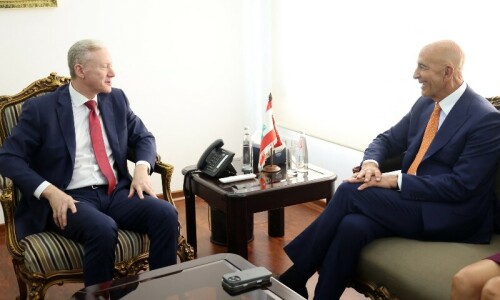
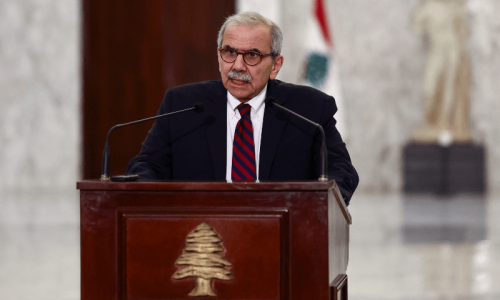
BEIRUT: Visiting US envoy Tom Barrack said on Monday that disarming Hezbollah was a domestic issue, as Washington presses the new authorities for action after the group was weakened by war with Israel.
“The Hezbollah disarmament… is something that is so internal,” Barrack told a press conference in Beirut after meeting Prime Minister Nawaf Salam, adding that if it didn’t happen it would be “disappointing”.
Lebanese leaders who took office in the aftermath of more than a year of hostilities including two months of open war between Israel and Hezbollah have vowed a state monopoly on bearing arms, while demanding Israel comply with a November ceasefire.
Israel has repeatedly bombed Lebanon, mainly saying it is targeting Hezbollah operatives and infrastructure, and has warned it will continue to strike until the group has been disarmed.
Barrack said the November cessation of hostilities between Israel and Hezbollah “didn’t work”.
Washington cannot ‘compel’ Israel to ‘do anything’
“America is not here to compel Israel to do anything. We’re here to use our influence to bring calm minds together to come to a conclusion,” he added.
Last month, Barrack asked Lebanese leaders to formally commit to disarming Hezbollah, the only group that retained its weapons after Lebanon’s 1975-1990 civil war.
“Your leaders have been more than helpful,” he said on his second visit to Beirut this month, adding that “the reforms that are happening… are amazingly plausible and significant”.
Barrack met with Lebanese President Joseph Aoun who gave the envoy a “draft comprehensive memorandum for implementing Lebanon’s pledges” since the ceasefire, a presidency statement said.
The draft emphasised the need to extend state authority to the entire country, restrict the bearing of weapons to the army and ensure “decisions of war and peace” rest with Lebanese constitutional authorities, according to the presidency statement.
Under the ceasefire agreement, Hezbollah was to pull its fighters back north of the Litani river, about 30 kilometres (20 miles) from the Israeli border, leaving the Lebanese army and United Nations peacekeepers as the only armed parties in the region.
Israel was to fully withdraw its troops from the country but has kept them in five areas it deems strategic.
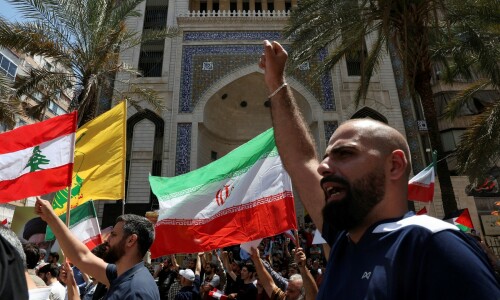
On Friday, Hezbollah chief Naim Qassem said his group was not ready to lay down its arms before an “existential threat” to Lebanon, adding that “we will not surrender to Israel”. The US “disarmament plan now, at this stage… is for Israel,” Qassem said.
“We are ready for any action that leads to a Lebanese understanding… but for Israel and America, we will not do this under any type of threat,” he said.
No US guarantees
Washington cannot “compel” Israel to do anything, U.S. special envoy Thomas Barrack said, in response to a reporter’s question about Lebanese demands that the US guarantees a halt to Israeli strikes on Lebanese territory.
Published in Dawn, July 22nd, 2025