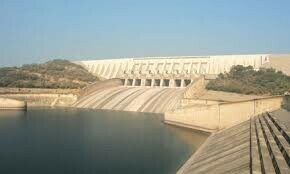
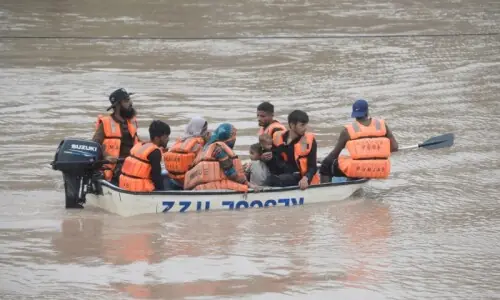
PESHAWAR: Before Kondal dam was built in Swabi district, even moderate rain would flood fields and inundate residential areas. Now, the reservoir not only stores rain and floodwater, but it also fulfils the irrigation needs of locals and has become a popular tourist attraction.
Kondal is one of the many small dams being built in northern Khyber Pakhtunkhwa and Punjab provinces as vulnerable communities look for cost-effective solutions to mitigate the impact of flooding, which has become more frequent due to climate change.
The impact of these extreme weather events are felt profoundly in northern districts of Punjab especially in Rawalpindi and Chakwal and Swat in KP, where topography and seasonal rainfall often combine to produce deadly torrents.
For communities living in these areas, small dams are the bulwark in their fight against climate change and flash floods.
These reservoirs mitigate impact of flooding, conserve water to fulfil irrigation needs of locals
According to Zafar Mahmood, a farmer from village Margoz in Swabi district, Kondal dam has had a positive impact on the lives of locals. He said the dam has been turned into a tourism destination in Swabi, attracting watersports and paragliding enthusiasts.
Cost-effective solution
These dams are also cost-effective.
Engineer Abdul Waheed Khan, a deputy collector at the KP Irrigation Department, said large dams take years to build and require financing of billions of rupees. However, a network of small dams, if strategically placed, can deliver significant flood protection with a fraction of the cost.
He said that Pakistan was blessed with several natural sites for the construction of dams in KP and Punjab provinces to avert floods and address the longstanding water woes of Pakistan.
Civil Engineer Fahim Munawar, an expert in dam construction, said small dams are becoming popular in developing countries due to their affordability.
These dams could easily be constructed in a short span of two to three years while big dams mostly require 10 to 15 years, he said, adding Pakistan may require an additional 76 MAF water by 2050 which was only possible by constructing small dams like Kondal in Swabi.
Water storage
According to hydrology experts, small dams perform a dual function of mitigating flood risks and conserving water. This makes them essential for Pakistan in the wake of climate challenges.
A water-scarce country, Pakistan lacks the capacity to store hundreds of thousands of cusecs of water, which gets wasted during the monsoon season.
The per capita surface water availability has significantly declined from 5,260 cubic metres in Pakistan in 1951 to around 1,000 cubic metres in 2016. This quantity is likely to further drop to 860 cubic metres in the next few years, marking Pakistan’s transition from a water stressed country to a water-scarce country, the policy revealed.
According to Tauheed Khan, former forests conservator of KP, Pakistan should swiftly shift its approach to construct small reservoirs instead of mega dams.
The KP government, with support from the Centre, has started the construction of several small dams as part of its climate adaptation strategy and controlling of flood damages. These projects often involve local communities in planning and maintenance, ensuring long-term sustainability.
Engineer Fakhar-i-Alam, the deputy director of small dams at the KP Irrigation Department, told APP that 24 small dams in different districts of KP with a storage capacity of 75,008acre feet were being constructed with the financial assistance of the federal government.
He said Pezu dam in Lakki Marwat, Khattak Bandhan dam in Kohat and Makh Banda dam in Karak were completed by the federal government. Similarly, Ichar and Manchura dams in Mansehra, Chashma Akora Khel dam in Karak, Sarozai dam in Hangu, Sanam dam in Lower Dir, Bada dam and Ulta dam in Swabi were constructed jointly by federal and provincial governments.
Seven medium dams, including Bara dam in Khyber, Tank Zam in Tank, Sheikh Haider Zam, Chaudwan Zam, Daraban, and Kora Nullah in DIKhan and Larzan small dam in Tank, with a water storage capacity of 520,884 acre-feet and a 31.5-megawatt power generation capacity, were in the design stage.
Published in Dawn, July 19th, 2025