Lahore received 207mm more rain than June/July average



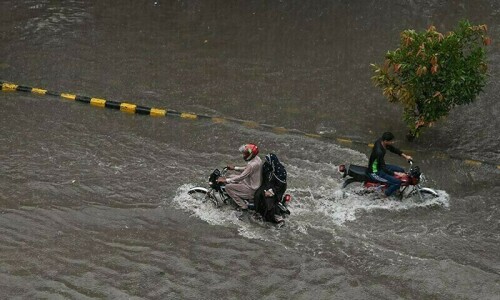
LAHORE: The Lahore metropolitan city has so far received over 207mm more rain from June 25 to July 15 than the average rain last year during the corresponding period.
According to a report shared by the Water and Sanitation Agency (Wasa) with Dawn, various parts of Lahore, during the aforementioned period, had received 270.7mm rain on average last year.
The Jail Road, Airport, Wasa Head Office (Gulberg), Lakshami Chowk, Upper Mall, Mughalpura, Tajpura, Nishtar Town, Chowk Nakhuda, Paniwala Talab, Farakhabad, Gulshan-i-Ravi, Iqbal Town, Samanabad, Johar Town and Qartaba Chowk had received 172mm, 176.1mm, 237mm, 376mm, 277.5mm, 282.5mm, 452mm, 284mm, 271.5mm, 290mm, 242mm, 277mm, 243mm, 250mm, 148mm and 354mm rain, respectively. From June 25 to July 15 this year, the rain gauged at the aforementioned parts of the city was 442.1mm, 426.3mm, 464mm, 593mm, 428mm, 465mm, 520mm, 628mm, 467mm, 606.5mm, 503mm, 379mm, 520mm, 416.5mm, 327mm and 467mm, respectively, making an average of 478.2mm.
“Though we are receiving more rain these days than last year, we are trying our best to deal with the situation by draining out the accumulated rainwater,” Wasa Managing Director Ghufran Ahmad said while speaking to Dawn on Thursday.
To a question, he claimed that a huge quantity of rainwater was harvested through rainwater harvesting ponds in the city.
“We have total 13 rainwater storage ponds in the city. Of these, 10 ponds were constructed during the current Punjab government,” he explained, adding that the stored water could be utilised for the watering trees greenbelts etc and other purposes.
To another question, he said the rainwater ponding duration has been reduced to three hours at the city’s major sore point, Lakshami Chowk, which used to take up to 24 hours in the past.
According to him, the raining pattern in Lahore and the rest of the country is different from other countries.
“In South Asian countries—Pakistan, Sri Lanka, Bangladesh and India, the intensity of rain is much higher than the rain pattern in Europe especially that receives drizzling. That’s why in Europe, there is no accumulation of rainwater. But on the other hand, we find our areas full of water due to continuous high-intensity rain that takes time to clear the areas of accumulated rainwater,” he explained.
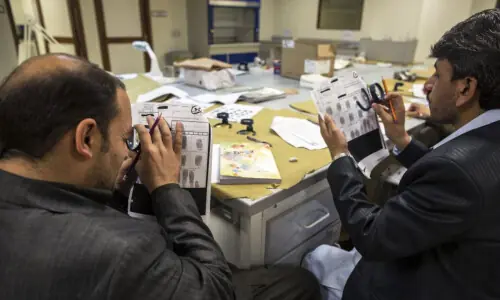
PHA: The Lahore Parks and Horticulture Authority (PHA) has installed biometric attendance machines at all its offices, while for the first time, the attendance of field staff is being recorded online via a modern mobile application.
According to a PHA spokesperson, supervisors have been assigned tasks in each zone to oversee and record the attendance of field staff through the mobile app.
PHA Director General Mansoor Ahmad stated that a transparent attendance system would enhance accountability and discipline within the organisation.
Published in Dawn, July 18th, 2025