0
0
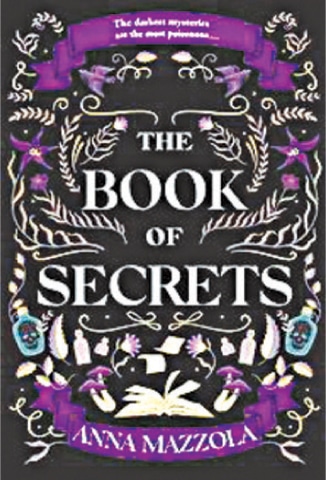
The Book of Secrets
By Anna Mazzola
Orion Books
ISBN: 978-1-3987-1432-8
374pp.
Anna Mazzola’s latest book, The Book of Secrets, which deals with 17th century Rome, reminds us that witchcraft, sorcery, black magic, poisons and potions to counter various ills are not just confined to our society. Neither are they new to the world. Now reduced greatly in the developed world, they were quite rampant in Europe a few centuries ago.
Mazzola is an award-winning novelist and writes historical and Gothic fiction. Her debut novel, The Unseen, won an Edgar Allan Poe Award. She is also a human rights and criminal justice solicitor, who works with victims of crime.
In The Book of Secrets, in the year 1659, months after the plague ravaged Rome, men were still dying in higher than expected numbers and there were rumours that their corpses didn’t seem to be decaying as quickly as they should, and still held a glow of health on burial. It is amid such rumours that Stefano Bracchi, a junior magistrate at the Papal Court, is commissioned by the governor of Rome to investigate the matter, albeit discreetly to avoid panic, and warned that he will need considerable mettle to reach the truth.
During the course of his investigations, Stefano, helped by a doctor who performed autopsies, begins suspecting that these men were being poisoned. Now the task becomes to get to the source of the poison. Digging into the matter, he discovers that, among a group of women who were making and selling beauty products and working to protect and help other women with childbirth, foretelling their futures etc, to bring solace in difficult times, one woman was also making poison. She was providing it under the cover of herbal remedies through a group of female associates, to women who claimed to be abused and tortured by their husbands, brothers and fathers.
The story unfolds through three narrators: Stefano, abuse victim Anna — the wife of a failed artist who vents his disappointments through violence — and Girolama, a Sicilian woman skilled in midwifery and the preparation of herbal remedies. Among other remedies, her most sought after product is a recipe known as ‘Aqua di Roma’, handed down to her by her stepmother and supposedly written in the ‘Book of Secrets.’
A historical novel, set in 17th century Rome, follows an investigation into the unusual deaths of men, the women who poisoned them and the network that supplied the poison
Stefano achieves a breakthrough when he succeeds in arresting one of the associates and, gradually, many members of Girolama’s gang as well as some women who are suspected to have poisoned their husbands are arrested. But he still has to reach the main poisoner, whom nobody is ready to name during investigations.
Stefano is faced with a dilemma: he is soft and gentle by nature but is being forced by his superiors to use force and harsh methods to extract confessions from the arrested women. To prove himself, he resorts to torture against his wishes. However, he begins to wonder whether the suffering he is inflicting on these women is justified for the sake of his career and success.
He becomes anguished as he realises what had driven these women to commit the crimes they did, as he could see some evidence of what they had gone through, and begins to question whether some acts should remain unpunished. He is torn between compassion for these poor women and the desire to keep his superiors happy, as well as to prove his mettle.
While Stefano is on the hunt for the poisoner, a package is found outside his residence that makes him suspect that witchcraft is being practised on him. As his investigations proceed, he starts feeling ill and thinks that it was the result of some black magic; he becomes indisposed for some time but, thankfully, it is after he has submitted his report to the governor and the Pope.
At one point, after many of her associates had been arrested, even Girolama begins to question whether she was justified in giving poison to every woman who claimed to have been abused, without checking if this were true, and whether every man who had subsequently died was an abuser. “She should have been more careful… She shouldn’t have sold the poison quite so freely,” she thinks as she worries about her associates imprisoned in Tor de Nona — a cold damp prison. But perhaps she was too troubled by her own experiences and just wanted to help ease their tortured lives.
Through Girolama’s history, one reads about the heritage of the healing women that is passed down from mother to daughter and travels from country to country. Her life story, though mentioned briefly, shows that she is a strong woman like the others in her family.
Seventeenth century Rome was a male-dominated society. Women had few, if any, rights, and were often left to find their own way to fight back. With abuse common and no way out of the peril they found themselves in, some were forced to seek help to bring their torment to an end. When Anna, the painter’s abused wife, goes to the priest for help, he tells her to “bend yourself to his will… It is the role of the wife to succumb to the will of her husband.” One is reminded of many instances where women in our country, even in the 21st century, are told the same thing.
Concerned about the arrest of her associates, Girolama wonders why “the Governor of Rome has no time to deal with men who beat their wives to death… or with men who take the honour of young girls, [but] as soon as one man is discovered dead, there must be a great inquisito with an army of officers and a whole prison given over to the suspects. Why does one man’s life count for more than a cartload of women’s?”
The story of The Book of Secrets is inspired by real events, where an inquisition was held against a group of women accused of selling poison in 17th century Rome, although the author has not stuck to the historical facts and made some changes while filling in some blank spots in the historical record. She admits in a ‘Historical Note’ that she has “intentionally diverged from the record that exists, in order to create a more satisfying and intelligible story.”
Though there is not much suspense in the book, as from the outset it is known who the main culprit is, one is pulled into the story expecting some last-minute twists or skeletons coming out of the closet (which they do) and one is not disappointed.
The reviewer is a freelance journalist. X: @naqviriz
Published in Dawn, Books & Authors, July 13th, 2025