Iran willing to talk, but Israel only looks to prolong war

• EU foreign ministers meet Araghchi; Tehran ‘ready to engage’ if Israeli hostilities stop
• Trump hints at US involvement in talks; says Tehran not interested in dialogue with Europe
• At UN Security Council, Pakistan joins calls to protect nuclear sites, citing global security risks
NEW YORK / GENEVA: Intense efforts to find a diplomatic end to the spiralling conflict between Israel and Iran got underway on Friday, as both the UN Security Council and European foreign ministers convened on opposite ends of the globe to try and convince both sides to de-escalate.
Foreign ministers from France, Britain, Germany and the European Union gathered at the German consulate in Geneva to meet Iran’s foreign minister on Friday in a last-ditch effort to broker a diplomatic off-ramp before US President Donald Trump’s self-imposed two-week deadline for a decision on US military involvement.
The meeting, which included France’s Foreign Minister Jean-Noel Barrot, Britain’s Foreign Secretary David Lammy, Germany’s Foreign Minister Johann Wadephul and the European Union’s foreign policy chief, Kaja Kallas, marked the first high-level face-to-face talks with Iran since Israel launched a wave of strikes on Iranian targets last week.
Following the meeting, the ministers said they are ready for more talks with Iran after discussions to try to restore a diplomatic path over its nuclear programme, Reuters reported.
“The good result today is that we leave the room with the impression that Iran is ready to further discuss these questions,” said German Foreign Minister Johann Wadephul in a statement alongside his British, French and EU counterparts after talks with Iranian Foreign Minister Abbas Araghchi.
However, Araghchi told Iranian state television on Thursday that “there is no room for dialogue until the aggression stops,” referring to ongoing Israeli strikes. “If others request to talk with us, we have no problem,” he said, but ruled out direct talks with the US while under attack.
The diplomatic effort by the European nations were disregarded by President Donald Trump, who, on Friday, indicated direct US involvement was key.
“We’ve been speaking to Iran, and we’ll see what happens,” he said. “Iran doesn’t want to speak to Europe. They want to speak to us. Europe is not going to be able to help in this.”
He said the two-week time was to “see whether or not people come to their senses.”
Security Council debate
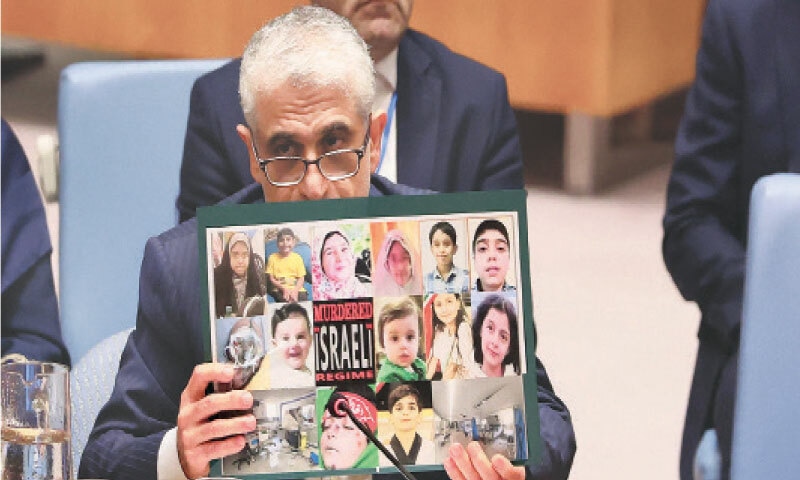
In New York, the UN Security Council convened an emergency session, the second in a week, at Iran’s request and with support from Russia, China and Pakistan. The meeting highlighted deep divisions and high tensions surrounding the conflict.
UN Secretary General António Guterres delivered a stark warning: “The expansion of this conflict could light a fire that no one can control. I appeal for an end to the fighting and the return to serious negotiations. Give peace a chance.”
Iran’s UN Ambassador Amir Saeid Iravani accused Israel of “deliberate war crimes, acts of state terror and an example of barbaric warfare”.
His Israeli counterpart, Danny Danon, countered fiercely, accusing Iravani of “playing the victim”.
“Israel will not stop. Not until Iran’s nuclear threat is dismantled.”
Dorothy Camille Shea, the interim US representative at the UN, condemned Iran as the “principal source of instability and terror in the Middle East” with the capabilities to produce a nuclear weapon.
Her statement was in stark contrast to the messages delivered just minutes before by the representatives of Algeria and Russia, who fully backed Iran.
Pakistan, which currently holds a non-permanent seat on the Security Council, joined Iran in warning that any attack on Iranian nuclear sites would pose a grave threat to regional and global security.
“Attacks against nuclear facilities for peaceful purposes are deeply troubling,” said Pakistan’s Ambassador Asim Iftikhar Ahmad. “It is the responsibility of the IAEA to clearly pronounce its legal position with regard to such attacks”.
Iran’s Iravani described Israeli strikes on Iranian nuclear sites as an assault on global non-proliferation efforts and warned that inaction by the Security Council would endanger broader global stability.
Conflict intensifies
The diplomatic scramble comes as Israel’s military campaign against Iran enters its second week. Israeli military chief Eyal Zamir said on Friday that the war would be “prolonged,” warning Israelis to prepare for “difficult days ahead”.
Israeli fighter jets continued strikes across Iran, hitting sites linked to missile systems and, according to the Israeli military, a “nuclear weapons project” research and development centre in Tehran.
Israel’s Army Radio also claimed the assassination of an Iranian nuclear scientist, bringing the alleged total to at least 11 since the conflict began.
The IDF also said it struck surface-to-air missile batteries in southwestern Iran.
Explosions were reported in Iran’s Khuzestan province, with IRNA news agency stating at least four people were killed.
Iran retaliated with missile barrages. One attack near Haifa’s port injured about 31 people, with President Isaac Herzog saying a mosque was hit.
Iranian strikes also targeted central and southern Israel, including a building in Beersheba.
Iran’s Revolutionary Guards claimed to have targeted military sites and air force bases with “long-range and ultra-heavy missiles.”
An Israeli military official said “approximately 20 missiles were launched towards Israel” in one salvo.
Published in Dawn, June 21st, 2025