Pakistan agreed to truce with India for sake of dialogue: Bilawal

KARACHI: Despite having the upper hand in the recent conflict with India, Pakistan agreed to ceasefire on the condition of dialogue to resolve all issues, former foreign minister Bilawal Bhutto-Zardari told reporters in London after the Pakistani delegation arrived from the United States, Dawn.com reported.
Pakistan has launched a broad-based engagement campaign to present its perspective on the recent conflict with India to the world and counter New Delhi’s unproven allegations. As part of its global outreach, the team recently visited the United States, and will head to Brussels next.
The delegation, led by Mr Bhutto-Zardari and consisting of Hina Khar, Khurram Dastgir, Sherry Rehman, Musadik Malik, Faisal Sabzwari, Bushra Anjum, Jalil Abbas Jilani and Tehmina Janjua, called for “intervention” from global powers in resolving key issues with India amid ongoing tensions.
Talking to reporters in London, Mr Bhutto-Zardari said, “We had the upper hand [during the conflict]. Despite that upper hand, we agreed to the ceasefire on the condition that there would be further dialogue in the future on all friction points at a neutral location.”
High-powered delegation reaches UK after wrapping up US visit, will proceed to Brussels next
Asked if he thought that the Kashmir dispute would soon be resolved after the US mediated the ceasefire, Bilawal expressed the hope that “moving forward, Trump or his government will keep its promise” as Pakistan’s defence position was better than India’s during the conflict.
“We hope that on an international level, whether it’s the United States or the United Kingdom, they all would play their role and convince India to resolve our issues through talks,” the MNA said.
The former foreign minister asserted that Pakistan had asserted its “strength” by taking down six Indian jets and now, peace needed to be established. He said those six jets were the “same as those that dropped their payload”, resulting in civilians’ deaths.
Throughout the conflict, the country was seen as a “rational and responsible state”, he added.
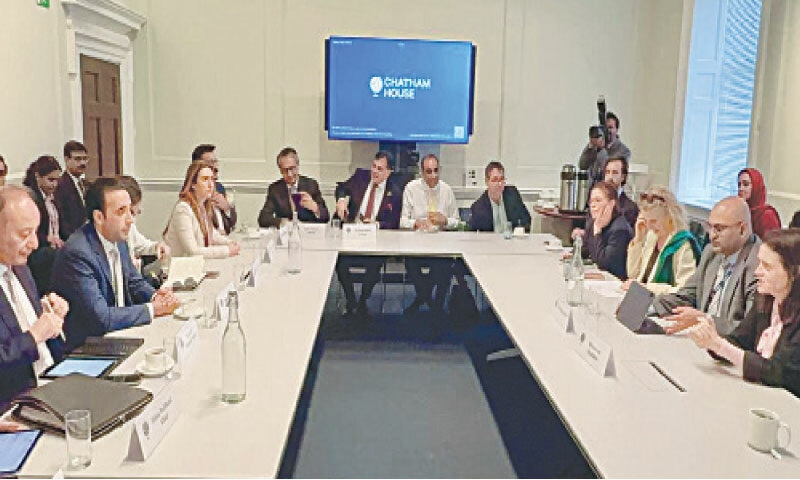
Meanwhile, the delegation led by Mr Bhutto-Zardari also engaged with eminent members of a British think tank, academia, and policymaking community at Chatham House.
During the closed-door discussion, the team conveyed Pakistan’s perspective on the recent escalation while “expressing serious concern about India’s unprovoked military aggression that resulted in civilian casualties and posed a significant threat to regional stability”, said a statement by the Pakistan High Commission in London.
It stressed that India’s actions constituted a clear violation of Pakistan’s sovereignty, international law and the UN Charter.
The delegation highlighted that the pending resolution of the Kashmir dispute remained the “principal stumbling block to lasting peace and stability in the region” and reiterated the call for global action to support meaningful dialogue and respect for international commitments.
Denouncing India’s move to unilaterally and illegally hold the Indus Waters Treaty (IWT) in abeyance, Mr Bhutto-Zardari warned, “The weaponisation of water undermines international norms and sets a perilous precedent”.
He urged the international community to take notice of the “alarming development and hold India to account for its actions”, according to the statement.
The delegation asserted that Pakistan’s response to India demonstrated the country’s resolve to defend its sovereignty and thwart “India’s ambitions to set any new so-called ‘normal’ in the region”.
Besides the delegation, Pakistan’s High Commissioner to the UK, Dr Mohammad Faisal, was also present during the roundtable conference.
The delegation also met UK’s Middle East minister Hamish Falconer and his team at the Foreign, Commonwealth & Development Office (FCDO), Dr Faisal said on X. Besides, the former foreign minister also attended a discussion with members of the International Institute for Strategic Studies, attended by its associate fellow for South and Central Asia, Desmond Bowen, according to his post.
In the UK, the team is set to hold meetings with the senior leadership of the UK Parliament, including the All Parties Parliamentary Groups on Pakistan and Kashmir, a press release had stated.
Published in Dawn, June 10th, 2025