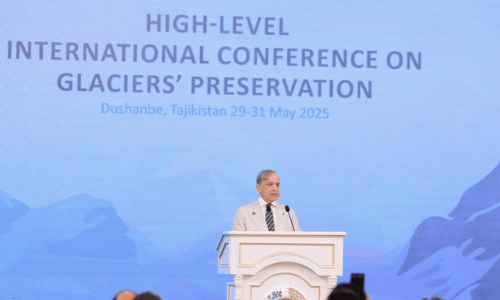
PRIME Minister Shehbaz Sharif has hinted at consulting the provinces regarding a plan to increase Pakistan’s water storage capacity to meet potential shortages after India announced last month that it was holding the Indus Waters Treaty in abeyance.
This is a good decision and should help prevent future controversies, especially where friction among the federating units over certain water storage projects in the past is concerned. Speaking at a jirga at the Corps Headquarters Peshawar on Tuesday, Mr Sharif also directed the authorities to speed up the construction of the Diamer-Bhasha hydropower project.
However, it is doubtful whether new water storage schemes are the answer to India’s threat of throttling the flows from the rivers allotted to Pakistan under the IWT or to the shortages in our rivers resulting from the impact of rapid climate change. So far as the Indian threat to Pakistan’s water security is concerned, this battle will have to be fought and won at the multiple dispute-resolution forums provided under the treaty if New Delhi tries to implement its illegal plan — at its own peril.
Meanwhile, a number of experts are of the view that the construction of new dams will not solve the problem of increasing water scarcity, especially when it becomes difficult to fill existing dams to capacity due to the increase in the number of dry and snowless days.
Rather, they say that dams would only worsen the impact of climate change by reducing flows into the rivers. Some even argue that such schemes are mostly pushed by lobbies that stand to financially benefit from them. Likewise, the plan to spend billions of dollars on expensive hydropower is hardly justified when the country has yet to harvest abundant solar and wind power at a fraction of its price. Such expensive projects are debatable amid a huge resource crunch.
As pointed out by the Planning Commission, the falling output of both industrial and food crops, owing to bad policies — as well as climate impact and higher input cost — is quite alarming.
If anything, Pakistan needs constantly flowing rivers regenerating hundreds of kilometres of adjacent aquifers for sustainable and affordable water harvesting for economic growth, food security and renewable energy, and not large dams or costly hydropower projects at the expense of other essential socioeconomic infrastructure.
Published in Dawn, June 5th, 2025