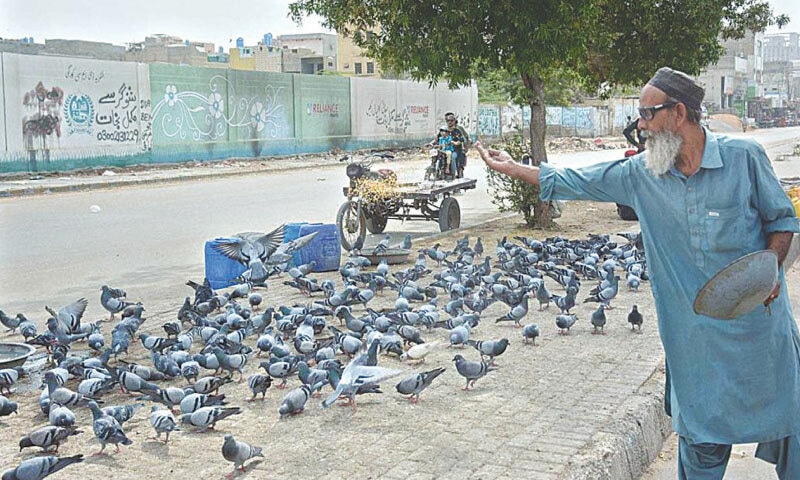

Every morning at a roundabout near Karachi’s Sindh Assembly, a middle-aged man scatters fistfuls of grain on to the pavement. In seconds, the air fills with the sound of fluttering wings and deep, grunting coos as hundreds of pigeons descend in a feathery storm. To him, it’s a job — and a spiritual duty. But what he doesn’t know is that with every breath, he’s slowly choking on kindness.
A little-known condition called pigeon or bird fancier’s lung (BFL) is quietly spreading across Karachi, and other big cities across Pakistan. It is triggered by the feathers and droppings of birds we feed daily, especially pigeons, but also parrots, budgerigars, cockatoos, finches, and even domestic fowl.
Feeding pigeons might look like a harmless act, but it’s causing serious problems globally and Pakistan is no exception. Rare until the last decade in the country, BFL is now becoming more common with the growth of pigeon-feeding sites in several public places.
Multiple roundabouts and thoroughfares, smack in the middle of dense residential and commercial districts of Karachi, host them in droves. There are also weekend bird markets, such as the ones in Saddar and Liaquatabad, where an unsuspecting population comes in the crosshairs.
Across Pakistan, feeding pigeons is triggering a rare lung disease — one that leaves permanent damage — with doctors worried that this crisis is only getting worse…
AN INVISIBLE THREAT
The allergy is caused by a tiny, powdery substance — called bloom — which is dispersed from flapping wings and drifts into homes through windows, balconies or air-conditioning ducts. It can affect not only bird handlers, but also those living close by the feeding sites, nests, and lofts, roofs and ledges where they perch. Once inhaled, the minute particles settle deep into the lungs and trigger a serious allergic reaction.
Experts say prolonged exposure to antigens can trigger BFL, a type of hypersensitivity pneumonitis (HP). If ignored, this allergic reaction can progress to interstitial lung disease (ILD), which causes permanent scarring (fibrosis) of lung tissue, significantly reducing oxygen exchange.
Prof Javed Khan, who is the head of the Pakistan Chest Society, estimates that there are 1,000 cases daily of BFL across major cities in the country, with around a million patients across the country with varying signs of respiratory distress. “From 2015 to 2025, cases of bird-related lung conditions have surged by over 10 percent, yet few hospitals are equipped to detect it early,” says Prof Khan, who is associated with the Aga Khan University Hospital (AKUH) in Karachi.
Dr Shakil Siddiqui, a chest specialist at the Civil Hospital Karachi, points out that lack of understanding among patients is often the reason for the condition to deteriorate. He cites the case of a 22-year-old youth employed to feed a flock of 400-500 pigeons at a busy roundabout, who came to him with complaints of a persistent cough and difficulty in breathing.
Dr Siddiqui tells Eos he diagnosed him with BFL and advised him to avoid the pigeons. The boy bluntly refused, saying that it was his bread and butter while also wondering how an innocuous bird could cause him any hardships.
While he took the medicine regularly, continues Dr Shakil, he never stopped working at the feeding site. Only after multiple painful episodes did he and his family finally accept the doctor’s advice and stopped the exposure, which eventually cured him.
The second case was that of a medical professional, a 35-year-old doctor, who thought he had some aggravated bacterial infection, but ended up in a hospital struggling to breathe, says Dr Siddiqui.
After running a few tests and taking the patient’s history, Dr Siddiqui says he told him that the patient’s pet parrot was causing the problem. On Dr Siddiqui’s advice, the patient parted ways with the parrot. “By day five, the tightness in his chest had loosened and, by day 12, he was breathing normally again,” Dr Siddiqui adds.
HEALTHCARE LIMITATIONS
At the Jinnah Postgraduate Medical Centre (JPMC), one of the largest public sector hospitals in Pakistan, a specialised clinic dedicated to HP has been set up, where patients are mandatorily asked about their exposure to birds, says Dr Kamran Khan Somalani, who heads the pulmonology department there.
“Unfortunately, patients often turn up at the hospital months later, gasping for air and requiring oxygen dependency,” Dr Kamran tells Eos.
One of the reasons for it, according to Dr Syed Ali Arsalan of the Liaquat National Hospital in Karachi, is that it’s hard to tell bird-related lung disease from others, as it requires a multidisciplinary approach to accurately diagnose the condition.
More importantly, says Dr Arsalan, most insurance companies don’t provide coverage for the special lung CT scan — which is critical to confirm the condition. “And most patients cannot afford it either,” adds Dr Arsalan regarding the procedure that can cost up to Rs50,000. It is against such a backdrop that most chronic patients visit hospitals, often in unbearable agony, he reveals.
AKUH is one of the tertiary care hospitals with the equipment and specialists to manage such cases, where doctors say cases have gone up from a handful of cases every week to closer to two dozen such cases. “As many as 40 percent of the patients come in the acute stage and 60 percent in the chronic stage,” says Prof Muhammad Irfan, who is part of the pulmonary and critical care department at AKUH. Most of the patients need long term care with steroids, oxygen therapy and cardiopulmonary rehabilitation to help their condition, he tells Eos.
Prof Irfan adds that when lung fibrosis becomes irreversible, following scarring of the lung tissue, a lung transplant is the last resort. “That is only possible in the UAE, India, China and Western countries,” he points out.
PERSONAL PROTECTION
Experts as well as doctors emphasise the importance of protective gear when dealing with birds. “It is important that bird handlers wear masks and keep cages outdoors,” says Prof Irfan. “Cleaning of the cage should always be done with water — not by sweeping — to avoid stirring up harmful dust,” he adds.
World Wildlife Fund-Pakistan ornithologist Jamshed Iqbal is against feeding pigeons, or kites and crows for that matter. He says it hurts the birds’ natural hunting instincts and leads to malnutrition. “The WWF research has established that feeding pigeons have outcompeted sparrows,” he points out. Because of their potential to disturb the ecological balance and to spread disease, several countries fine those bent upon feeding birds or any other animals in the wild, Iqbal adds.
To control the pigeon population, Iqbal recommends humane methods of reducing littering, using sound-based bird repellents, contraceptive feed or introducing natural predators such as falcons to control the pigeon population.
As pigeons continue to flock to public feeding spots, their flutter of wings is a scary warning. One that lands softly, but scars for life.
The writer is a journalist based in Karachi
Published in Dawn, EOS, May 25th, 2025