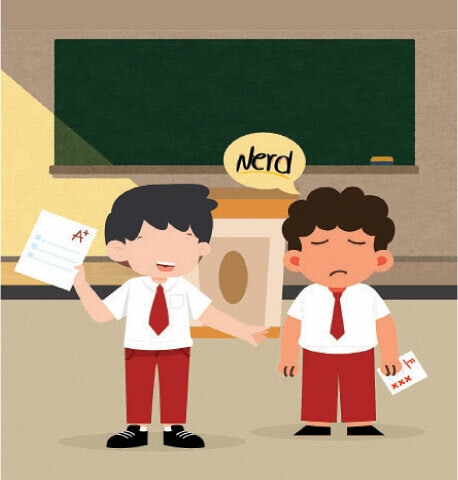
“Ibrahim, you need to do better,” I heard the teacher tell Ibrahim as she started handing us our marked test papers.
When the teacher handed me my paper, I was surprised to see I had scored full marks. I was so happy seeing that my hard work had paid off.
“Good job! I knew you would score good marks again,” exclaimed our teacher.
But I noticed Ibrahim didn’t like the comment, and said, “Nerd!” His friend sitting next to him laughed.
“That’s not a nice thing to say Ibrahim. He works hard, but I see this annoys you! How fair is this?”
He sat silently, but it was evident from his expression that he was not happy.
After some time, when the class was about to end, our teacher informed us that we had another test later that week. After hearing what Ibrahim said, I started to feel that I might have made him feel embarrassed or inferior by scoring significantly higher than him. Deep down, I believed that I was somehow responsible for his bad behaviour and the sense of inferiority that seemed to make him angry and negative.
Because of this, I decided not to study for the upcoming test. On the test day, I deliberately wrote most of the answers incorrectly, though not all of them, so that the teacher wouldn’t get suspicious.
As a result, I had scored 21 out of 40, while Ibrahim had scored 33. I noticed his facial expression; he looked relieved and wore a triumphant smile on his face.
“So, Raheel, you finally scored lower than me. This just proves I can be better at studies, too!” Ibrahim said with a grin.
I was confused. Thoughts raced through my mind: how could he think this way? Why was he mocking me, even after I had deliberately given him a chance to score higher?
“Raheel, come outside the classroom with your test paper,” my teacher said.
I walked out, my mind swirling with questions. Had she figured out that I had intentionally answered incorrectly? Outside, she looked at me with an expression that carried both disappointment and pity.
“Give me your paper,” she said. I handed it over, and she flipped through it slowly before speaking.
“In most of these problems, you wrote the correct formulas and even did the calculations correctly, but your final answers are wrong, as if you did it on purpose. Am I right?”
I hesitated, then explained the situation. I told her how I had felt responsible for making Ibrahim feel inferior and how I thought that letting him do better in one test might ease that tension.
She was silent for a moment, then looked me in the eye and said, “Raheel, you have nothing to prove to Ibrahim or any of those boys. You studied hard and earned your marks, didn’t you?”
“Yes,” I replied quietly.
“Then don’t let their behaviour take that away from you. Got it?”
Her words stayed with me. As I walked back into the classroom, Ibrahim and his friends burst out laughing.
“How does it feel to be a nerd?” one of them sneered.
I cleared my throat and said calmly, “Sometimes it is the mercy of those nerds that you get a chance to shine, but you are hopeless. I have realised this. I work hard for my marks, while you waste time trying to bring others down. The truth is, you’re the insecure ones.”
This time, they had a confused expression, but they became quiet. From that day on, they never bothered me again. And I realised something important, I have nothing to prove to anyone but myself.
Published in Dawn, Young World, May 24th, 2025