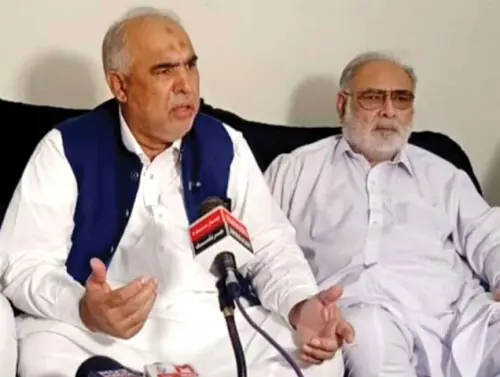
ISLAMABAD: The Judicial Commission of Pakistan (JCP) has decided to appoint Acting Chief Justice of the Balochistan High Court Justice Muhammad Ejaz Swati as its permanent chief justice.
A meeting of the JCP was convened on Monday at the Supreme Court to consider nominations for the position of the BHC chief justice. Following deliberations, the commission unanimously recommended the appointment of Justice Ejaz Swati as permanent chief justice of the BHC.
The JCP was originally scheduled to consider the appointments of permanent chief justices for the BHC, Sindh High Court, Peshawar High Court and Islamabad High Court on Monday. The meeting had previously been set for April 18, then rescheduled to May 2, and again to May 19, with the expectation of finalising nominations for all four high courts.
However, the JCP, headed by Chief Justice of Pakistan Yahya Afridi, later issued a notification stating that the meeting was deferred without assigning a new date. No official reason was provided.
The delay comes amid an ongoing constitutional challenge before the Supreme Court’s constitutional bench concerning the transfer of three judges from other high courts to the IHC — Justice Sardar Muhammad Sarfraz Dogar from the LHC, Justice Khadim Hussain Soomro from the SHC, and Justice Muhammad Asif from the BHC. The Ministry of Law had issued the transfer notifications on Feb 1, after which the IHC revised its seniority list on Feb 3, ranking Justice Dogar as the senior puisne judge.
This revision sparked opposition from five IHC judges — Justices Mohsin Akhtar Kayani, Tariq Mehmood Jahangiri, Sardar Ejaz Ishaq Khan, Babar Sattar and Saman Rafat Imtiaz — who challenged Justice Dogar’s seniority and his subsequent appointment as acting chief justice on Feb 12.
The Supreme Court is currently hearing multiple petitions related to the issue, including those filed by the IHC judges, former prime minister Imran Khan and four bar associations. These petitions have challenged the legality of the judge transfers, the revised seniority list, and the Feb 8 decision rejecting the judges’ objections.
The Supreme Court registrar had defended the transfers, citing Article 200(1) of the Constitution, which allows the president to transfer judges with their consent and after consultation with the CJP and the respective high court chief justices.
Published in Dawn, May 20th, 2025