0
0

Whether it’s the defence of the skies in 1965, the downing of Indian pilot Abhinandan Varthaman in 2019, the very recent downing of Indian Air Force Rafales, or the dismantling of the enemy’s air defence systems also in the current crisis, the Pakistan Air Force (PAF) is rich with the ingredients for gripping, high-stakes storytelling.
Yet, despite its cinematic potential, only a handful of Pakistani films over the years have looked to the skies to explore the drama and glory of aerial warfare. These rare productions serve as both a tribute to our heroes in the sky and a reflection of an industry gradually feeling technically confident enough to embrace aerial defence narratives.
Overall, however, while Bollywood has ‘celebrated’ even the downing and capture of Abhinandan by Pakistan — spinning a highly fanciful yarn that flies in the face of reality in the process — Pakistani films have lagged behind and even PAF’s real victories have rarely been brought to the big screen.
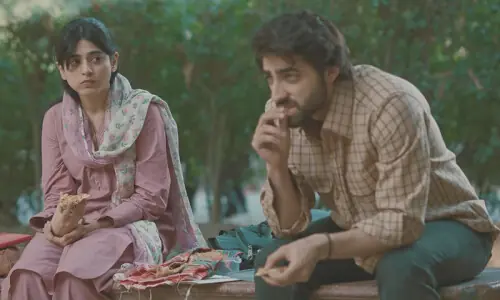
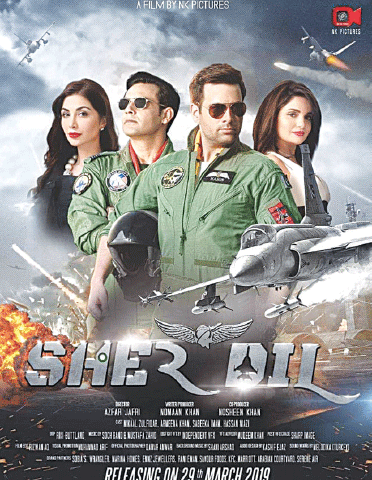
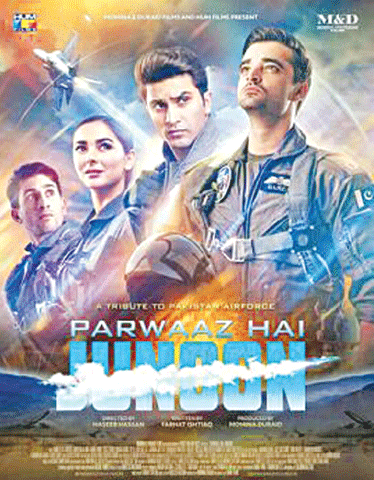
For millennials, Qasam Uss Waqt Ki might be better known as a patriotic anthem, once sung by the late singer-turned-naatkhwaan Junaid Jamshed, while films such as Sherdil (2019) and Parwaaz Hai Junoon (2018) stand out as relatively recent portrayals of high-octane dogfights and Top Gun-style aerial action.
Despite Pakistan Air Force’s stories being rich with the ingredients for gripping, high-stakes cinema, very few films have been produced centred around them. With the smashing successes of Operation Bunyan-al-Marsoos, perhaps it’s high time that this gap is addressed…
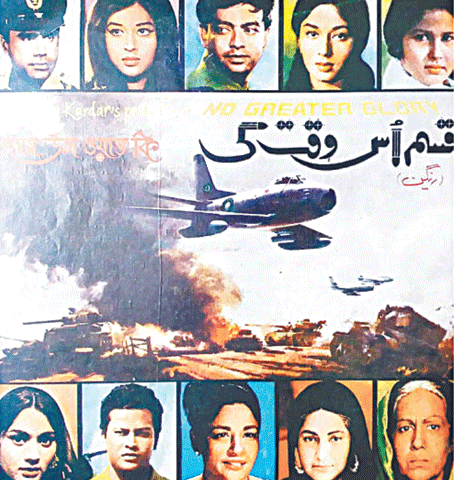
But decades earlier, there was a film by the same name — Qasam Uss Waqt Ki (1969) — which was the only serious attempt at the time to spotlight the courage and valour of the PAF on the big screen. Ironically, it was hit by bad timing (waqt).
In 1968, as anti-Gen Ayub protests intensified, relations between East and West Pakistan grew increasingly strained. The arrest of Shaikh Mujibur Rahman in connection with the Agartala Conspiracy Case further underscored the deep political, economic and cultural divisions, fuelling nationwide unrest, tensions that would ultimately contribute to Pakistan’s break-up.
Amid such a tense climate, the PAF decided to raise the stakes by producing a national unity film — one that would not only bridge the gap between the two wings of the country, but also showcase the PAF as a symbol of strength and inspiration for the nation and the world.
The film’s story follows Squadron Leader Javed (Tariq Aziz), whose plane crash-lands in East Pakistan after heroically shooting down five enemy jets. This was meant to pay tribute to Squadron Leader M.M. Alam’s legendary five kills during the 1965 war.
After the crash, Javed is cared for by Shabnam (Shabnam), a nurse in Dacca (Dhaka), and the two fall in love. Meanwhile, Javed’s mother — played by veteran Lollywood actress Swaran Lata — has already arranged Javed’s marriage to his cousin Razia (Saiqa). However, the love between Javed and Shabnam remains unwavering.
A parallel storyline unfolds around Javed’s sister Nasreen (Rozina), who is in love with her brother’s friend, Flight Lt Mobin (Hasan Imam), an officer from East Pakistan. Their budding romance adds to the emotional complexity of the family situation.
Caught in the middle of these intertwined love stories, the mother finds herself at the heart of a double dilemma and is on the verge of intervening when war suddenly breaks out. Javed is recalled to duty and ultimately martyred, leaving a trail of grief and heartbreak in his wake.
The story closely resembles producer/actor Waheed Murad’s Samandar (1968) where the characters of Noori (Shabnam) and Raja (Waheed) symbolically represent Dacca and Karachi, respectively. The two lovers live in a fishing colony until a foreign hand attempts to disturb the peace.
Interestingly, Rozina — who plays Tariq Aziz’s sister in Qasam Uss Waqt Ki — also portrayed Waheed Murad’s sister in Samandar, and her character was in love with Hanif, a Dilip Kumar-lookalike.
In Samandar, a boat race ultimately determines the community’s leadership, ending on a note of triumph and unity. In stark contrast, in Qasam Uss Waqt Ki, the ‘race’ unfolds in the skies, culminating not in celebration but in shahadat [martyrdom].
Made in both Urdu and Bengali, Qasam Uss Waqt Ki was directed by A.J. Kardar, who also wrote the screenplay to the story written by Professor Ahmad Ali and Commander Shahid Hussain. It was Kardar’s second collaboration with the revolutionary poet Faiz Ahmed Faiz, as they had both worked together for Jaago Hua Savera (1959), Pakistan’s first official submission for the Best Foreign Language Film at the 32nd Academy Awards. Although that film did not receive a nomination at the Oscars, it gained international recognition at the first Moscow International Film Festival, where it was awarded the prestigious Golden Medal.
PAF brought together the trio of Kardar, Faiz and Khan Atta-ur-Rehman (music director, Jaago Hua Savera). Famous broadcaster and DG Radio Pakistan Z.A. Bokhari was tasked with writing the dialogues. The lyrics were crafted by renowned poets Faiz, Josh Malihabadi, Fayyaz Hashmi and Khan Atta-ur-Rehman, while the vocal talents of Mujeeb Alam, Runa Laila, Mehdi Hassan, Bashir Ahmed, Sain Akhtar and Farida Khanum brought them to life. Sohail Rana and Nathoo Khan were roped in for the songs, while veteran music director Rafiq Ghaznavi took care of the background music.
Songs such as the titular ‘Qasam uss waqt ki’ (originally sung by Mujeeb Alam), ‘Sab qatl ho ke tere’ (Farida Khanum), ‘Manzilain shauq-i-deedar ki manzilain’ (Mehdi Hasan), ‘Raat youn dil mein teri khoi hui’ and ‘Us dhoop kinare shaam dhalay’ still remain popular, continuing to evoke powerful moments of patriotism. ‘Ek tum ho ek main hoon’, a duet by Runa Laila and Bashir Ahmed, was sung in both Urdu and Bengali, symbolising a fleeting but poignant hope for unity across borders.
As the armed forces faced growing challenges and ‘Field Marshal’ Ayub Khan was not as popular as he was in 1965, it became a pivotal moment for the PAF to step forward and help restore faith. It left no stone unturned to make sure Qasam Uss Waqt Ki was a hit — they recruited Hollywood’s Mervyn Marshall, a renowned cinematographer, for ‘closer to reality’ aerial shots, while Squadron Leader A.I. Bokhari served as his deputy.
Qasam Uss Waqt Ki premiered on December 12, 1969, at Karachi’s Nishat Cinema, with President Gen Yahya Khan attending the event. However, by then, the political climate had already shifted; Ayub Khan had been ousted earlier in the year, and it was probably too late to reconcile East-West sentiments. Despite being a well-made film, its timing was unfortunate, landing it in a politically charged and challenging situation.
The film bombed — pardon the pun — at the box office, yet the good thing was that it became a tradition in PAF schools to show the film to young minds. The young guns would come out blazing as the movie inspired them to join the forces and serve in the Pakistan Air Force.
Sadly, with the situation in East-West changing, in August 1971, Pilot Officer Rashid Minhas was martyred in a heroic struggle with his Bengal-born instructor Mati. The 20-year-old lad brought down his plane after a fistfight with his instructor, refusing to divert his plane to India. His martyrdom led to his posthumously receiving the highest military honour, the Nishan-i-Haider.
Around the same time, veteran actress Shamim Ara was producing the film Farz, starring herself and Syed Kamal in the lead roles. Heavily inspired by the Rajesh Khanna and Sharmila Tagore-starrer Aradhana (1969) — which in itself was based on the American film To Each His Own (1946) — the film progressed smoothly until someone saw the potential end in the Rashid Minhas story.
In Aradhana, the son (played by Rajesh Khanna) recognises his mother at the end and celebrates her sacrifices. However, in Farz (released in 1973), the son dies in a dramatic confrontation with his instructor, that too in the skies above, mirroring Shaheed Rashid Minhas’s heroic sacrifice.
Those are the only two major ‘Air Force’ tributes we have had over the years until the very late 2010s when, thanks to Tom Cruise’s Top Gun (1986), filmmakers were once again inspired to depict the PAF as a formidable force in Pakistani films. However, as pointed out earlier, despite Parwaz Hai Junoon and Sherdil, none ventured into making a Bollywood-style blockbuster centred around the Pakistan Air Force. Films such as Bilal Lashari’s Waar (2013), Hassan Rana’s Yalghaar (2017) and Shaan Shahid’s Zarrar (2022), all showcased the Pakistan Army, yet the PAF didn’t receive the spotlight it deserved.
With the accomplishments of Operation Bunyan-al-Marsoos on our side, it’s high time the Pakistan Air Force gets a film of its own. After all, all the dashing elements are already there. Ask any woman about PAF spokesperson Air Vice Marshall Aurangzaib Ahmed.
Published in Dawn, ICON, May 18th, 2025