US, China agree to slash tariffs in trade war de-escalation


 0
0


The United States and China announced on Monday an agreement to drastically reduce tit-for-tat tariffs for 90 days, de-escalating a trade war that has roiled financial markets and raised fears of a global economic downturn.
After their first talks since US President Donald Trump launched his trade war, the world’s two biggest economies agreed in a joint statement to bring their triple-digit tariffs down to two figures and continue negotiations.
US Treasury Secretary Scott Bessent described the weekend talks with Chinese Vice Premier He Lifeng and international trade representative Li Chenggang as “productive” and “robust”.
“Both sides showed a great respect,” Bessent told reporters.
US President Donald Trump had imposed duties of 145 per cent on imports for China last month — compared to 10pc for other countries in the global tariff blitz he launched last month.
Beijing hit back with duties of 125pc on US goods.
Bessent said the two sides agreed to reduce those tariffs by 115pc, taking US tariffs to 30pc and those by China to 10pc.
In their statement, the two sides agreed to “establish a mechanism to continue discussions about economic and trade relations”.
China hailed the “substantial progress” made at the talks.
“This move… is in the interest of the two countries and the common interest of the world,” the Chinese commerce ministry said, adding that it hoped Washington would keep working with China “to correct the wrong practice of unilateral tariff rises”.
The dollar, which tumbled after Trump launched his tariff blitz in April, rallied on the news while US stock futures soared. European and Asian markets also rallied.
The trade dispute between Washington and Beijing has rocked financial markets, raising fears the tariffs would rekindle inflation and cause a global economic downturn.
‘Bodes well for the future’
The head of the World Trade Organization, Ngozi Okonjo-Iweala, praised the talks on Sunday as a “significant step forward” that “bode well for the future”.
“Amid current global tensions, this progress is important not only for the US and China but also for the rest of the world, including the most vulnerable economies,” she added.
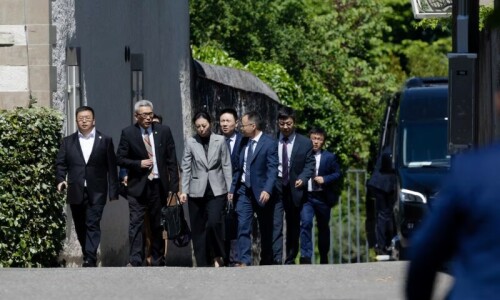
Ahead of the meeting at the discreet villa residence of Switzerland’s ambassador to the United Nations in Geneva, Trump had signalled he might lower the tariffs, suggesting on social media that an “80% Tariff on China seems right!”
However, White House Press Secretary Karoline Leavitt later clarified that the United States would not lower tariffs unilaterally, saying China would also need to make concessions.
The Geneva meeting came days after Trump unveiled a trade agreement with Britain, the first with any country since he unleashed his blitz of global tariffs.
The five-page, nonbinding deal confirmed to nervous investors that Washington was willing to negotiate sector-specific relief from recent duties.
But Trump maintained a 10pc levy on most British goods, and threatened to keep it in place as a baseline rate for most other countries.