The impact of colonialism at a glance
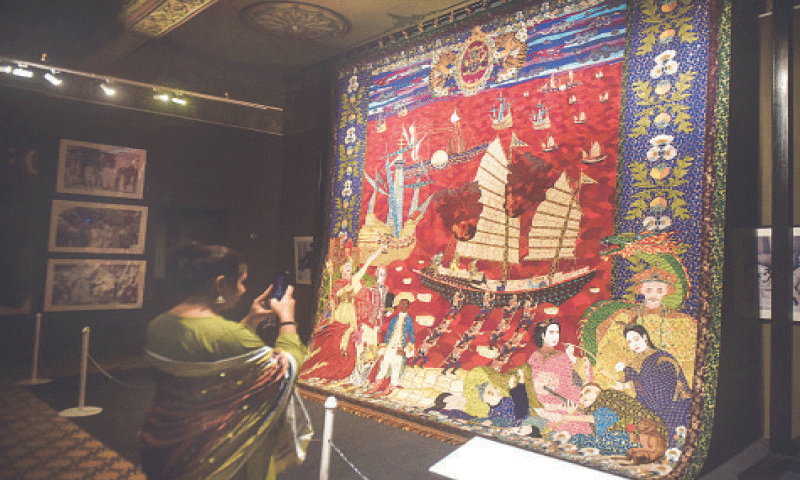

KARACHI: There is a 210 x 188 inches tapestry that hangs in a gallery of the Mohatta Palace Museum that gives you the story of greed, of how Britain completely destroyed China by giving them opium.
“Imperium Amidst Opium Blossoms: A Kashidakari on the Era of the East India Company” by Adeela Suleman showcases key figures from the East India Company as well as its impact on India, China and Wales.
Mohatta Palace Museum in collaboration with the Glynn Vivian Art Gallery, Swansea, Wales unveiled the tapestry on Thursday in the form of a preview before it is taken to the ‘Tigers & Dragons: India and Wales in Britain’ exhibition to be held at the Glynn Vivian museum in Wales from May 23 to November 2.
The tapestry or kashidakari is a special commission for the exhibition. Through silk applique work and hand-stitched its embellishments, the piece tells the story of Robert Clive, who won the Battle of Plassey in 1757 and who is known to have laid the foundations of the British Empire in India. His son, Edward Clive, was the governor of Madras (now Chennai) and was involved in Tipu Sultan’s death. The loot collected by Robert Clive and his son from all over was Powis Castle in Wales.
Tapestry put on display showcases key figures from British, Indian and Chinese history
Besides British oppression in India, Suleman’s tapestry also reflects on the Chinese Opium Wars of the 1800s, instigated by the East India Company in the name of free trade. Since the British made the Chinese opium addicts so that they can exchange it for silk, the tapestry uses silk material.
Since opium is obtained from poppy flowers, the tapestry also has poppies, although white in colour. But the entire piece is predominantly red. “The red represents the river and the poppies are white. So the blood has been drained out from the flowers,” explained Suleman at the unveiling.
She also pointed out the hallucinating opium addicts in the picture. They include a Chinese aristocrat. There are also junk boats in the red river and a British warship. And at the bottom of the picture there is the body of Tipu Sultan with British Army officer General Sir David Baird, who had been taken captive by Tipu Sultan for many years, standing beside it. The tigers in the picture don’t really represent the tiger of Mysore, Tipu Sultan, but the tigers on the logo of the East India Company and the red dragon in there are not for China but the emblem of Wales which has a red dragon. Somewhere in there you also find an African boy to show slavery.
“Some characters are missing in the tapestry,” Suleman pointed out, adding that she hoped to bring them into her next tapestry. She also thanked her team of artisans who helped her create the work through intricate embroidery and fine stitching. The tapestry has a different back. The applique work there has trees and peacocks over white.
The Managing Trustee of Mohatta Palace Museum and CEO of Dawn Media Hameed Haroon said that the tapestry basically shows the impact of colonialism exercised on all the countries colonised by the British. “It shows the state of violence used against the people they ruled over,” he said.
“Tipu Sultan was a symbol of resistance and Adeela has brought him in the picture to show that,” he added.
He also said that the Chinese in the 1600s were the most developed people. “Economically, they were dynamic. But the West destroyed them to satisfy their greed,” he said.
Earlier, while introducing Suleman, the Director of Mohatta Palace Museum, Nasreen Askari, said that as a young adult she had witnessed vicious police attacks and tear gas, etc, in the Premier College in Nazimabad No 1, which in the Karachi of those times was a hotbed of radicalism. Therefore, she is no stranger to terror and violence, which has turned her into a kind of “warrior” by her own admission.
Published in Dawn, May 9th, 2025