The human cost of a conflict
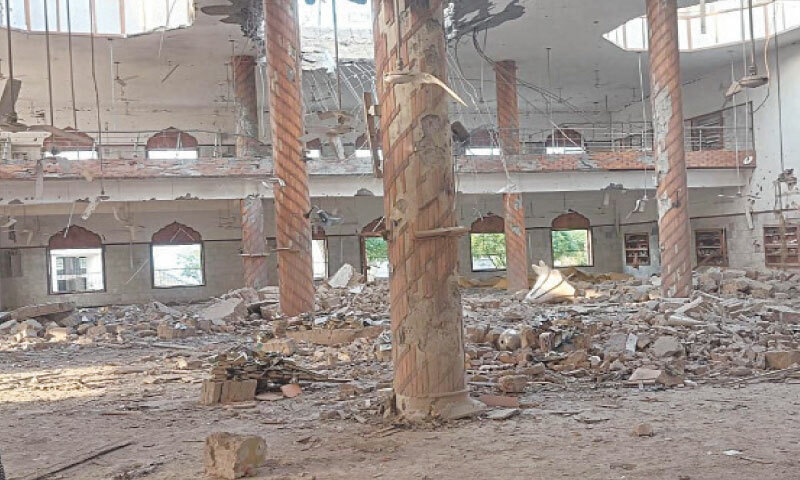


On a quiet evening in Bahawalpur, a series of events unfolded that may change the lives of countless individuals. Residents from various neighbourhoods in the city, ranging from the close vicinity of a mosque to farther areas such as Model Town Avenue and Satellite Town, experienced the shock waves of Indian airstrikes that caused panic, destruction, and fear.
Recounting the traumatic moment, Shahzaib explained how his motorcycle fell due to the impact of an explosion nearby. “I felt explosions around me, my mind went blank,” he recalled, his voice trembling as he continued. “I saw smoke coming out of a building but had no idea what had happened.”
Chaos reigned around him as people screamed in fear while others were in a state of shock. Amid the panic there were some who remained seemingly unaffected, continuing their meals in a nearby restaurant, situated around four kilometres from a mosque named Subhan. This contrast between fear and normalcy painted a disturbing picture of disarray that followed the airstrike.
Ghafoor Chishti, a citizen and owner of a kiln, also recounted his experience. As he was about to go to bed, he was jolted by an explosion. “I felt walls of my house crumbling.”
As Chishti and his family scrambled to understand what was happening, residents from nearby areas like Cheema Town and Punjab Housing Society rushed towards the mosque.
One of the most harrowing accounts came from Usman Chaudhry, a resident of Model Town Avenue. He left for duty after the third Indian airstrike, but ended up at the CMH (Combined Military Hospital) with multiple injuries and a broken arm.
“From a distance, Sajju, a resident of Citylight Town, located 10km from the mosque, also experienced the aftershocks of the airstrikes. She was asleep when explosions awoke her.
“At first I thought my solar panel had burst,” she said, recalling the moment when the bang rattled her home. Rushing to the roof of her house, she found no damage but could hear distant cries and sirens of ambulances on the streets..
Muhammad Musan Munawar, a resident of Model Avenue, only 3km away from the mosque, shared a similar experience. He was at home with his wife, Tasnim, when the ground seemed to be shaking.
“The doors of our house were rattling like something heavy had fallen on our roof. It was around 12:34pm. When I came outside with my wife, we could hear a loud noise coming from the back of the house.”
The two rushed to investigate, only to find no visible damage. As they stood outside, the noise continued to grow louder. His young daughter woke up, confused and frightened, asking what was happening. They tried to reassure her, but there was little they could do. On their way to the roof, they found no signs of immediate danger. However, they soon noticed strange lights in the forest area near the city. When they checked their phones for updates, an announcement came from mosque loudspeakers, urging people to turn off their lights and seek shelter.
The announcement suggested that India had launched an airstrike on Pakistan. The tension was palpable as another explosion rocked the area roughly an hour later.
“The second explosion came without warning,” Musan recalled.
“That’s when my children started crying uncontrollably. The fear in their eyes was something I’ll never forget.”
The collective experiences of these residents reveal a city thrown into a chaos by the devastating effects of airstrikes. The airstrike not only caused widespread damage but also brought a profound sense of uncertainty and fear to the people of Bahawalpur.
As the situation unfolded, the sense of community became increasingly apparent. People from all walks of life came together, offering support, sharing information, and helping one another. These first-hand accounts serve as a powerful reminder of the human cost of conflict.
Dr Sadia Kamal also contributed to this report
Published in Dawn, May 8th, 2025