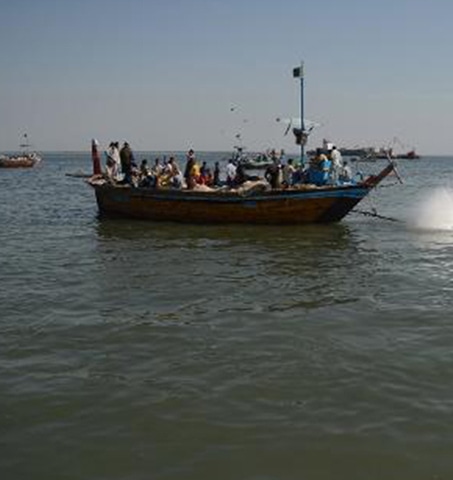
THE smuggling of contraband items through Pakistan’s high seas remains largely unnoticed even though it is a serious threat. Reportedly, the smugglers exploit the Arabian Sea to bring in contraband goods, including heroin, hashish, methamphetamine and liquor. Arms and ammuni-tion as well as extremely high-value commercial goods are also smuggled through these coastal waters.
Pakistan’s 1,000-kilometre-long coastline, stretching from the creeks of Thatta and Badin to Karachi and onward to Gwadar in Balochistan, remains particularly vulnerable to the illicit movement of such banned items. This alarming situation raises serious concerns about the per-
formance and capacity of the law-enforcement agencies (LEAs) responsible for monitoring and safeguarding the country’s maritime domain.
Pakistan Customs is the lead agency mandated to prevent and interdict maritime smuggling within the country’s territorial waters. However, it faces significant limitations in terms of resources and operational capacity. Even basic surveillance assets, such as high-speed fibre-reinforced plastic patrolling boats, are lacking, let alone advanced tools, like drones, radar systems and satellite monitoring.
With constrained infrastructure and limited maritime assets, Customs is unable to independently conduct anti-smuggling operations on the high seas and must frequently rely on joint efforts with the Pakistan Navy, Pakistan Maritime Security Agency (PMSA), and Pakistan Coast Guards. Customs, in collaboration with these agencies, seizes substantial quantities of both contraband and non-contraband items.
Nonetheless, the illegal movement of dangerous goods through maritime channels continues to pose a grave risk to national security and public health. It also threatens our economic stability.
In the light of this reality, it is imperative for the policymakers to take immediate and practical steps to strengthen coastal security. First and foremost, Customs must be equipped with adequate physical, technological and human resources to fulfil its counter-narcotics and anti-smuggling mandate effectively. A robust and formalised mechanism for joint operations involving all the relevant stakeholders should be institutionalised to ensure a sustained deterrence against smuggling activities.
The government must also ensure strict monitoring of informal jetties, such as Kuntani in Balochistan, that are frequently used for offloading smuggled goods. Surveillance and operational oversight at officially designated coastal points, like Sonmiani, Ormara, Kund Malir, Keti Bandar, Jiwani and Pasni, should be significantly enhanced. These areas are widely believed to be the key transit points for narcotics and liquor entering the country illegally.
To support enforcement efforts, a centralised database should be developed by Customs to document all types of vessels operating in the country’s maritime domain, including local boats, fishing trawlers, commercial ships and foreign vessels. International cooperation with coastal neighbours and global maritime security organisations is also essential for long-term control of transnational smuggling networks.
Strengthening maritime zones is not only vital for combating smuggling, but also for safeguarding Pakistan’s blue economy, and ensuring the sustainability of maritime commerce and economic development.
Shahid Ali Abbasi
Karachi
Published in Dawn, May 5th, 2025