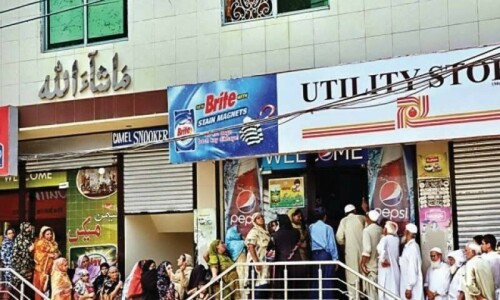
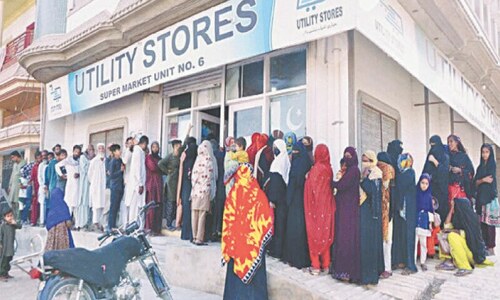
ISLAMABAD: The National Assembly’s Standing Committee on Privatisation was informed on Wednesday that under the restructuring plan of USC, 1203 Utility Stores have been closed while 2237 employees have been laid off till date.
A senior official of the Utility Stores Corporation further informed the committee that only 1500 stores will now be functional and that too on commercial basis. The committee inquired that if Utility Stores Corporation is run now on commercial basis and earns profit then what is justification to give priority to it.
The USC official briefed the committee about subsidies provided to the USC, profit earned and tax paid.
The representative of ministry of privatisation replied that a presentation on it will be given to the committee in the next meeting, stating that it depends on policy decision by the government and profitable entities may also be privatised. The committee recommended that the decision of USC privatisation must be reviewed in the larger interest of the country and a large number of employees and their families.
Discrepancies of up to 30 years found in some of the 5,131 pension cases flagged during PAC meeting
Chairman of Privatisation Commission informed the committee that for privatisation of Hesco, Pesco and Fesco, terms and conditions for privatisation are under consideration and financial adviser for due diligence will be hired, audit and accounts will be maintained and power division has given time till September or October 2025, and the privatisation process will start by end of May.
The committee expressed serious reservations on appointing board of governors of power companies and recommended that competency must be observed while appointing boards. The committee also directed that CEOs must attend the next meeting in person.
The representative of Postal Life Insurance Company Limited informed the committee that the company has about three lakh customers and Rs8 billion has been sought from the ministry of finance this year. The committee directed that last 4 to 5 years figures must be provided and the policy holders must be protected. The finance ministry should clarify the status of funds of PLICL, the committee observed.
On the issue of the privatisation of Pakistan Engineering Company (Peco), officials requested the committee to allow more time to resolve the issue.
The committee approved three months’ time and directed to resolve the issue within due time and recommended that Chairman and MD must be appointed from majority of shareholding instead of government nominees.
PAC meeting
The Public Accounts Committee meeting held here on Wednesday focused on audit objections related to the Ministry of Overseas Pakistanis.
Chaired by MNA Junaid Akbar Khan, a major concern raised during the PAC meeting was the payment of over Rs2.79 billion in old-age pensions based on questionable or incorrect dates of birth.
According to audit officials, discrepancies of up to 30 years were found in some of the 5,131 pension cases flagged.
Officials noted that over 10 million workers were registered, with pensions currently being disbursed among around 800,000 individuals. The secretary of the Ministry of Overseas Pakistanis, Arshad Mahmood, informed the committee that prior to the establishment of Nadra in 2000, identification and verification of individuals were based on systems other than Nadra-issued ID cards.
This explanation drew criticism from the PAC Chairman, who questioned the inconsistencies between birth dates on ID cards and academic records.
The committee granted the ministry one month to resolve the issue and submit a comprehensive report in this regard.
Workers’ rights and factory conditions
During the meeting, concerns were also raised about the state of workers’ welfare and factory oversight.
Committee member Shazia Marri emphasised the lack of job security and the distressing behaviour of some employers towards their employees.
Riaz Fatyana highlighted the alarming number of tuberculosis cases among workers working in textile factories and pointed out poor working conditions and lack of health safeguards. Mr Fatyana said that several new factories do not even have proper records and criticised the lack of documentation and regulatory oversight.
Published in Dawn, April 24th, 2025