Big industry shrinks 3.5pc in March

ISLAMABAD: The Large-Scale Manufacturing (LSM) sector continued to show sluggish performance as production contracted by 3.51 per cent in February compared to the same month last year, according to data released by the Pakistan Bureau of Statistics on Tuesday.
On a month-on-month basis, the LSM recorded a negative growth of 5.90pc.
The negative growth was recorded despite a 1,000 basis points cut in the key interest rate to 12pc since the start of the current fiscal year.
The big industry production has experienced a downward trend since August 2024, except for October, influenced by domestic and global factors. The LSM exhibited positive growth from December 2023 to May 2024, subsequently transitioning into negative territory in June 2024.
A cut of 1,000bps in the interest rate has failed to revive economic activities
On a YoY basis, LSM dipped 2.65pc in August, followed by a decline of 1.92pc in September. However, it recorded a paltry growth of 0.02pc in October before contracting by 3.81pc in November, 3.73pc in December and 1.21pc in January. The LSM expanded 2.38pc in July 2024.
The LSM recorded a negative growth of 1.90pc during the first eight months of the current fiscal year. In FY24, the LSM sector contracted 0.03pc against a 0.92pc growth in the preceding year.
The food group dipped by 2.68pc in 8MFY25. However, wheat and rice milling rose 6.39pc, starch and its products 0.50pc, respectively, owing primarily to improved crop harvests. Vegetable ghee production declined by 2.60pc, cooking oil by 0.05pc and tea blended by 3.44pc.
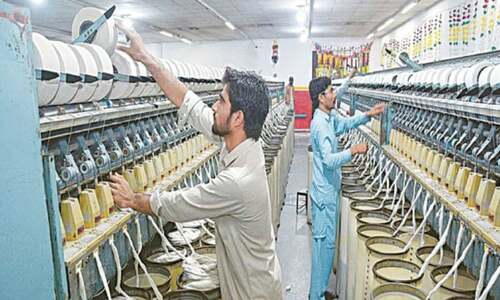
The textile sector grew 1.78pc in 8MFY24. Cotton yarn production increased by 8.31pc and cotton cloth by 0.79pc, accounting for more than 80pc of the textile sector. The primary cause of the rise was a slight increase in export unit value in the face of higher external demand for textiles.
The export of garments grew 8.65pc in 8MFY25, primarily due to diverting foreign purchasers from Bangladesh to Pakistan.
Coke and petroleum products grew 4.56pc in 8MFY25. The petrol production increased partially by 0.49pc. However, the production of high-speed diesel rose by 8.91pc, kerosene by 27.76pc, followed by lubricating oil by 4.21pc, furnace oil product by 2.92pc, jute batching oil by 54.50pc and solvent naphtha by 30.04pc. The LPG production dipped 3.54pc and jet fuel oil 10.40pc.
The automobile sector grew 43.31pc in 8MFY25, driven by a 39.15pc surge in jeeps and car production, followed by light commercial vehicles 198.97pc, trucks 106.71pc, and buses 55.95pc. However, the production of diesel engines declined by 8.95pc during the months under review.
In the last few years, the automotive industry has grappled with multiple challenges, including a decline in demand, exacerbated by factors such as rising car prices due to inflation and currency fluctuations. Moreover, non-enticing auto financing options offered by banks further dampen consumer interest.
The production of pharmaceutical products grew 2.03pc. However, the production of fertilisers declined 1.63pc.
Iron and steel production declined 11.70pc in 8MFY25. Billets/ingots, mostly consumed in the construction industry, experienced a 28.26pc fall. Similarly, H/CR sheets/strips/coils/plates grew adversely by 2.40pc.
Published in Dawn, April 16th, 2025