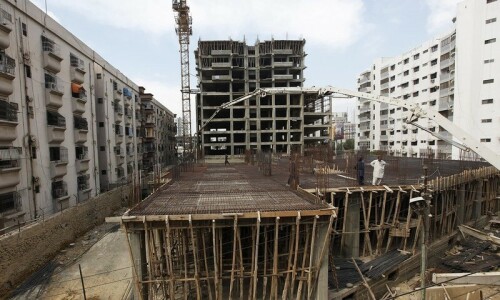
KARACHI: Around two dozen residents of Old Clifton have moved the Sindh High Court against some recent amendments to the Karachi Building and Town Planning Regulations (KBPTR) 2002 through which the Sindh Building Control Authority has allowed commercial use of residential properties.
A two-judge bench, headed by acting Chief Justice Muhammad Junaid Ghaffar, issued notices to the local government department, SBCA, advocate general and others for April 22.
Mehdi Chagla, Kamal A. Chinoy, Zahid Hamid Maker, Majid Bashir Ahmed, Samir M. Chinoy, Khwaja Ahad Rahma and 15 other Clifton residents filed a petition through their counsel Arshad Tayebaly and cited LG secretary, director general of SBCA, Karachi Development Authority, Karachi Metropolitan Corporation, Sindh Master Plan Authority and Sindh Environmental Protection Agency as respondents.
They pleaded to declare the impugned amendment ultra vires to the Sindh Building Control Ordinance, 1979 (SBCO) and other relevant laws as well as without lawful authority and of no legal effect.
Many Clifton residents ask SHC to set aside changes to Karachi Building and Town Planning Regulations
The petitioners’ counsel submitted that the amendments in question were made to the KBTPR 2002 through a notification issued on March 13 by the SBCA.
He argued that the SBCA had abruptly and without any lawful authority amended the definition of various regulations of KBTPR by substituting the meaning of ‘amenity plot’, ‘commercial’ and ‘residential uses’.
He submitted that Regulation 19.2.1 earlier defined as “residential uses” had been recently amended by inserting a new definition of “recreation uses” which included activities, facilities and spaces that facilitate leisure, social interaction and community well-being.
The counsel maintained that this encompassed dining and social establishments such as cafes, food courts and similar venues, provided they contribute to the recreational and communal experience of the neighbourhood.
He argued that such an amendment was against the very definition of “residential uses” and would practically lead to conversion of a residential property into a commercial one without fulfilment of any requirements for change of land use as provided in the KBTPR 2002.
He also submitted that such changes cannot be sustained as the parent law did not provide for any such authority either to the SBCA or the master plan department.
He contended that the amendment in question was amount to permitting a radical and abrupt change in the zoning regulations/master plan of the entire city to the detriment of all residents.
The counsel informed the bench that after such changes, the respondents hastily permitted conversion/declaration of residential properties for their usage as commercial without due process, which was against the law as well as judgements of SHC and the apex court.
He also sought an interim relief by asking the court to restrain the respondents from acting further till the final adjudication of the petition.
The bench in its order stated, “Contention requires consideration; therefore, let notice be issues to respondents as well as advocate general for 22.04.2025. Notice may also be issued to the advocate general under Order 27-A CPC for the next date as vires of law are under challenge.”
The petitioners submitted in the petition that the preamble of the SBCO made it abundantly clear that the SBCA’s jurisdiction pertained to planning and construction of buildings, prices charged for disposal of buildings and plots by builders and demolition of dangerous buildings in the province.
Therefore, they stated that the conversion and usage of land came outside the scope of SBCA’s domain and solely rested with the land holding authorities being the KDA and KMC, etc.
The petitioners also maintained that the SBCA has deprived the government of billions of rupees in revenue, which was otherwise to be recovered through conversion fees and charges and the impugned amendment was a backdoor attempt at high-density or mixed-use conversion without formally declaring zones under the Sindh High Density Development Board Act 2010.
Published in Dawn, April 9th, 2025