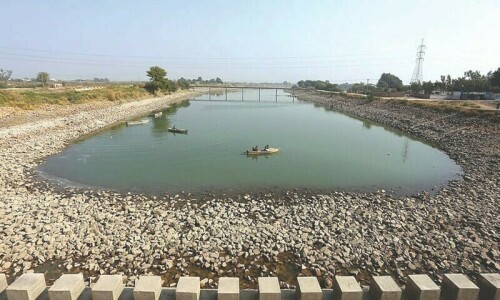
Pakistan, home to over 250 million people, is edging close to a deeper water crisis.
Climate change is tightening its grip, with rising temperatures, shrinking glaciers, and increasingly erratic rainfall. As a result, the water supply has become less reliable than ever. Hotter days mean higher evaporation, driving up demand for both drinking water and crop irrigation — which consumes over 90 per cent of the country’s available water.
At the same time, the expansion of cultivated land, rising cropping intensity, and a rapidly growing population are placing an even greater strain on already-stretched water resources. By an unfortunate twist, recent drought-like conditions and the ongoing heated debate around the six proposed canals have thrown the issue into sharp focus.
Over the past few decades, climate change, the environment, and the water sector have taken a back seat to large infrastructure projects like highways, underpasses, flyovers, and city bypasses; this neglect has come at a cost. As a result, many parts of Pakistan today face extreme water stress for crop irrigation — and for some, even access to drinking water will be a challenge in the years to come.
Beneath the surface, things are no better. Groundwater is depleting at an alarming rate due to our rising dependence on it, as river flows continue to dwindle. Indiscriminate pumping continues unchecked, further fuelled by solar panels. Even in irrigated areas, water tables are declining by more than five feet each year. Compounding the issue, water quality is also worsening as a result.
Pakistan should prioritise rainwater harvesting as a key solution to address its declining groundwater levels
Though the issue has come to the limelight, and recently the Lahore High Court urged the Punjab government to declare a water emergency, yet meaningful progress remains elusive. There is still no clear policy, no coherent strategy, and little public investment to turn things around. Unlike other countries in the region, Pakistan still lags in adopting proven technologies for water storage and groundwater recharge.
One such technology is the inflatable rubber dam — a sealed, flexible structure installed across water channels. Made of durable, waterproof material, these dams typically span hundreds of metres in length and stand 1-3 metres in height. Anchored to a concrete foundation with bars and bolts, they are inflated with air or water to form a rigid barrier.
Widely used in several countries across Europe, North America, and Asia, inflatable rubber dams serve multiple purposes — from storing water and controlling floods to recharging groundwater aquifers — each tailored to meet specific regional needs and environmental conditions. Japan and China lead globally with thousands of such installations. Bangladesh has also built dozens since the 1990s. Most recently, in 2025, Kazakhstan installed similar dams in its Kostanay region.
Unfortunately, despite identifying over 30 viable sites along the Jhelum, Chenab, Ravi, and Sutlej rivers, the Punjab government has spent the past decade in indecision. Not a single inflatable rubber dam has materialised. The plans gather dust while billions are funnelled into highways and other concrete-heavy projects that offer far more political visibility than long-term water security. It’s a telling reflection of misplaced priorities.
Another cost-effective, high-impact technology is groundwater recharge wells that have been largely overlooked in the past despite their immense potential to combat falling water tables and mitigate urban flooding. During heavy rains — particularly in the monsoon season — farmers often struggle to drain excess rainwater from their fields. They even shut off their canal watercourses and skip their weekly irrigation turns.
Likewise, in urban areas, rainwater from rooftops inundates roads, residential areas, and commercial hubs. Eventually, all this surplus water flows through flood drains, into rivers, and finally into the sea — a tremendous loss in a water-scarce country.
Unlike other countries where rainwater harvesting mainly serves as a substitute for water transported from distant sources, Pakistan should prioritise it as a key solution to address its declining groundwater levels.
Therefore, there is an urgent need to harvest this untapped resource — and that starts with promoting groundwater recharge well technology on a large scale across both rural and urban areas. The key lies in mobilising the private sector to manufacture and supply the necessary components.
A similar approach has worked before: Punjab’s On-Farm Water Management programme introduced precast concrete parabolic lining and nurtured a large pool of local manufacturers. Initially serving government projects, these businesses now sell directly to farmers, who look to reduce their individual on-farm water losses.
In conclusion, Pakistan ranks among the 10 countries most vulnerable to climate change, and the drought-like conditions witnessed in recent months may intensify in the years ahead. Enhancing surface water storage is one solution — but equally important is replenishing the country’s overexploited groundwater reserves.
The path forward demands not just awareness but actions — a decisive course correction and a collective effort to secure the nation’s water future — before it’s too late.
Chaudhary Mohammad Ashraff is the former Director General (On-Farm Water Management) of the Punjab Agriculture Department, and Khalid Wattoo is a farmer and a development professional.
Published in Dawn, The Business and Finance Weekly, April 7th, 2025