0
0
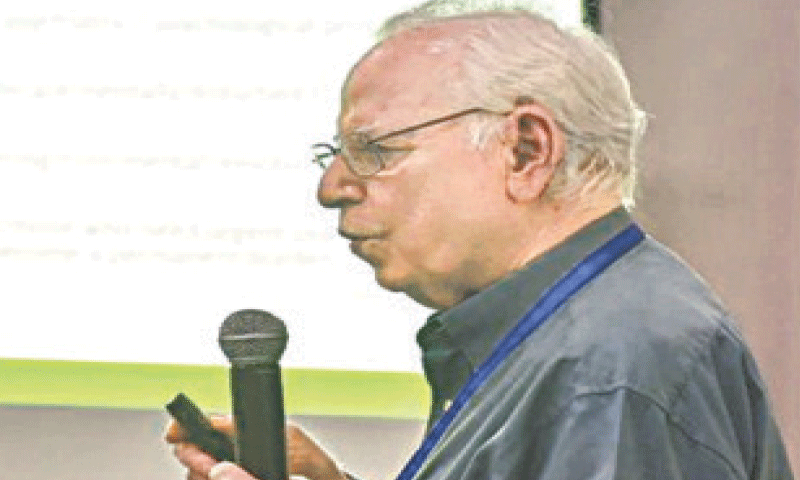

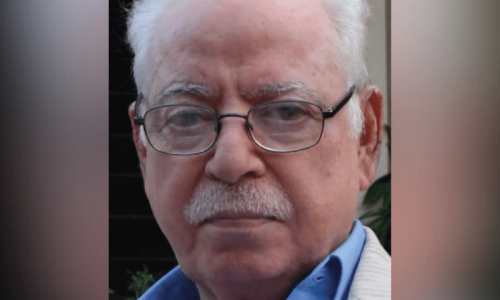
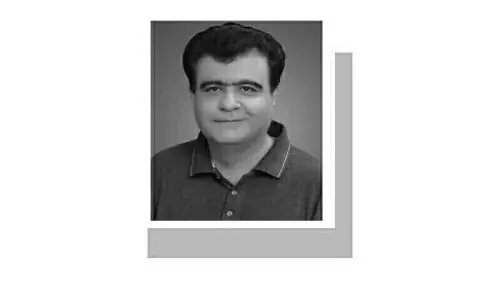
SYED Haroon Ahmed, one of the country’s leading psychiatrists and a prominent civil and human rights activist, passed away in Karachi on Thursday. He was 92.
Dr Haroon’s overriding ability and unflinching faith in the betterment of the masses, including his patients, gave him a special place in society, not only as a physician but also as a teacher and a mentor.
Born in Jaunpur, Uttar Pradesh, his family migrated to Pakistan after Partition, where he commenced his professional and political journey from the Dow Medical College.
At the time, the institution was considered a bastion of student activists with a progressive mindset, who dreamed of establishing an egalitarian society based on justice, equality and democratic values.
The young Haroon was one of the founding leaders of the Democratic Students Federation (DSF), which carried this message.
Many medical students remained part of this struggle, including the likes of Dr Mohammad Sarwar and Dr Mir Rehman Ali Hashmi.
Dr Haroon remained committed to the cause of human rights, minority rights and secularism all his life.
He assumed a leading role in the circle more as a theoretician, and traveled to a number of Communist countries before completing his postgraduate degree from the UK in the field of psychiatry.
He joined the Jinnah Hospital before it was called Jinnah Post Graduate Medical Centre and accomplished a milestone when he succeeded in establishing a separate wing in the hospital and introduced psychiatry as an independent clinical subject.
Forceful, yet soft-spoken, Dr Haroon advocated the need for an extensive medical network in the field of mental health. Because of his vibrant personality and extraordinary persuasive power, everybody wanted to know and listen to him.
In his message, Pakistan Association for Mental Health (PAMH) president Dr Syed Ali Wasif described Dr Haroon as having “played a pivotal role in shaping modern psychiatry”.
“As a senior psychiatrist at Jinnah Hospital’s Ward 20, he contributed significantly to the development of psychiatric care [in the country]. He co-founded the Pakistan Psychiatric Society in 1972 and, earlier in 1965, established the Pakistan Association for Mental Health (PAMH).”
Beyond his contributions to mental health, he was a fervent advocate for peace and human rights. As president of the International Physicians for the Prevention of Nuclear War, he was one of the few courageous voices to campaign against Pakistan’s nuclear armament in 1998.
Dr Haroon’s dedication to human rights was further reflected in his long-standing association with the Human Rights Commission of Pakistan (HRCP).
Dr Wasif recalled that one of Dr Haroon’s most significant contributions was in mental health law reform. “Recognising the outdated nature of Pakistan’s psychiatric legislation, he spearheaded efforts to replace the archaic Lunacy Act 1912.”
“His perseverance led to the passage of the Sindh Mental Health Act of 2013, the first law in Pakistan to provide safeguards for individuals with psychiatric illnesses, including those accused under blasphemy laws. His relentless advocacy ensured its enactment, leaving an indelible mark on the country’s legal framework,” the PAMH president said.
He was also one of the founding trustees of the Sindh Institute of Urology and Transplant (SIUT).
Dr Haroon is survived by his wife Anis Haroon — a known political figure and social activist — as well as two sons and a daughter. A large number of people from the medical fraternity and defenders of human rights, social justice, and freedom of expression also mourn him.
His funeral will be offered after Friday prayers today at the Masjid Abu Bakr Siddiq, near Bilawal House Chowrangi, Clifton Block 2, and he will be laid to rest in a graveyard in Korangi.
Published in Dawn, April 4th, 2025