Climate change has already hit livelihood of millions in Pakistan: finance minister


Finance Minister Muhammad Aurangzeb on Friday said that climate change had already impacted food production and the livelihood of millions in Pakistan.
Pakistan was ranked as the most vulnerable country to climate change in 2022, followed by Belize and Italy, according to data in the Climate Risk Index (CRI) for 2025 report released by European think-tank Germanwatch last month.
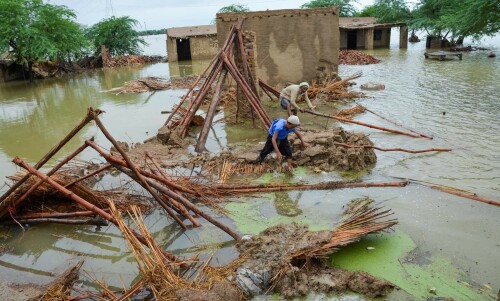
Pakistan’s ranking was mainly due to the unprecedented floods in 2022, primarily caused by record-breaking monsoon rainfall, glacial lake outburst floods (GLOFs), and other factors.
Addressing a ceremony in Islamabad marking the first ‘World Day of Glaciers’, the finance minister said: “This disturbed water cycle [due to rising global temperatures] in turn is already impacting crop yields, food production and the livelihood of millions.”
Speaking about the 2022 floods, he said, “In the flooding of 2022, GLOF events struck and from what I understand Pakistan has a little over 3,000 glacial lakes, 33 of which are highly volatile putting a little over seven million people in danger.”
He added that these statistics were large and alarming and therefore the work being done in terms of coming up with a Pakistan glacial protection and resiliency framework was a very timely action.
“While financing is critical, the real challenge for us is capacity building,” the finance minister observed.
He said that although Pakistan had received pledges of $10 billion after the 2022 floods, but only received one-third of that as “we could not come up with investable, bankable products and that is what we need to work on.”
The first ‘World Day of Glaciers’ is being observed today and will set a platform dialogue and action regarding the state of the world’s glaciers and the impacts of the melting cryosphere on global water, food and energy security.
Observing the day in Pakistan, the government is launching the country’s first ‘Glacier Conservation Strategy’, reinforcing collective efforts to protect these vital ecosystems.
Continuous glacier retreat also leads to extreme events and new and evolving disaster risks for downstream populations and vulnerable transport and energy infrastructure such as glacier lake outburst floods, landslides or enhanced erosion and sediment.
Glaciers are crucial for regulating the global climate and providing freshwater, essential for billions of people. However, due to climate change, driven mainly by human activities since the 1800s, these vital resources are rapidly melting.
The United Nations has designated 2025 as the International Year of Glaciers’ Preservation to highlight the importance of glaciers and ensure that those relying on them, and those affected by cryospheric processes, receive the necessary hydrological, meteorological, and climate services.
These efforts underscore the critical role mountain regions play as a key source of global freshwater and ecosystem services.