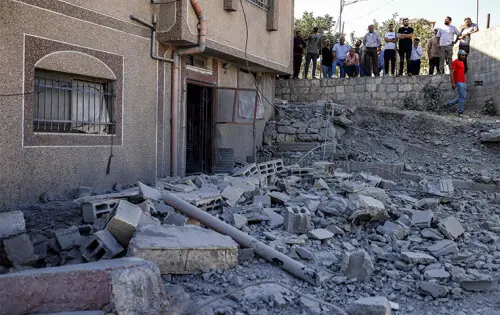
LATAKIA: Syria’s new authorities announced on Monday the end of an operation against loyalists of deposed president Bashar al-Assad, after nearly 1,000 civilians were killed in the worst violence since his overthrow.
The Syrian Observatory for Human Rights war monitor reported the mass killings of at least 973 civilians since Thursday, the overwhelming majority of them members of the Alawi minority executed by security forces or allied groups.
The fighting in the coastal heartland of the Alawi minority to which the ousted president belongs has threatened to throw into chaos the country’s fragile transition after decades of the Assad clan’s iron-fisted rule.
The authorities on Monday ended their sweeping “military operation” against security threats and “regime remnants” in Latakia and Tartus provinces on the Mediterranean coast, defence ministry spokesman Hassan Abdul Ghani said in a statement on official news agency SANA.
Sharaa says country will not face civil war again
The announcement came after interim president Ahmed al-Sharaa, whose group Hayat Tahrir al-Sham (HTS) led the offensive that toppled Assad on December 8, said the country would not be dragged into civil war again.
“Syria... will not allow any foreign powers or domestic parties to drag it into chaos or civil war,” Sharaa said in a speech posted by SANA.
He also vowed to “hold accountable, firmly and without leniency, anyone who was involved in the bloodshed of civilians... or who overstepped the powers of the state”.
In Jableh in Latakia province, a resident spoke to AFP in tears, requesting anonymity for safety concerns and saying they were being terrorised by armed groups who had taken control of the town.
“More than 50 people from among my family and friends have been killed. They gathered bodies with bulldozers and buried them in mass graves.”
In some areas, residents began tentatively venturing out but many were still afraid to leave home after dark and complained of a lack of basic supplies. “Today the situation in Latakia is a little calmer, people are out and about after five days of anxiety and extreme fear,” said Farah, a 22-year-old university student who gave only her first name.
But with the situation still “very tense”, she said that “after six o’clock, you do not see anyone in the street... the neighbourhood turns into a ghost town.”
Clashes broke out on Thursday after gunmen loyal to the deposed president attacked Syria’s new security forces.
Published in Dawn, March 11th, 2025