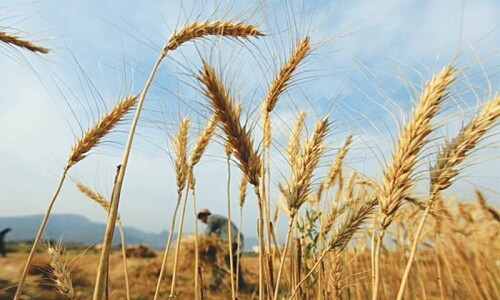
‘Insecure’ wheat growers switching to other cash crops


ISLAMABAD: The removal of government support prices, along with low domestic rates, has affected the current sowing season, causing wheat farmers to switch to more profitable vegetables and cash crops, such as mustard and pulses.
The Country Brief on Pakistan, published by the UN Food and Agriculture Organisation (FAO), says the area planted declined year-on-year since the government removed the minimum support price in May 2024.
The FAO report made available on Saturday says that wheat production in 2025 will depend on the performance of the rainy season until April.
According to the report, despite well-below-average cumulative precipitation amounts and warmer-than-average temperatures between October 2024 and early February 2025, vegetation conditions in the main wheat cropping areas were average to above average due to a sufficient supply of irrigation water.
Number of population facing acute food insecurity falls
However, dry weather conditions negatively affected crop emergence and early development in rain-fed areas, known as barani, which account for about 20 per cent of the total planting, and in some minor irrigated areas in northern parts of the country due to shortage of irrigation water.
In these areas, FAO’s Agriculture Stress Index (ASI), as of early February, indicated that cropland was affected by drought conditions, suggesting unfavourable yield prospects.
Cereal production
The cropping season finalised in December 2024 and aggregate cereal production is estimated at a record level of 56.6 million tonnes. Production of wheat in 2024 is officially estimated at a record level of 31.4m tonnes, reflecting large sowings and excellent yields, supported by an adequate supply of irrigation water and widespread use of high-yielding seed varieties.
Similarly, production of paddy crop is estimated at a record level of 15.2 million tonnes, primarily due to an increase in sowings, driven by high prices at planting time. Production of maize is estimated at an average level of 9.5 million tonnes.
Wheat import
Wheat import requirements in the 2024-25 marketing year (April/March) are forecast to be negligible, if compared to the previous five-year average, mostly owing to the record production harvested in 2024.
Although the country was traditionally a wheat exporter, unusual large volumes of wheat were imported between 2020-21 and 2023-24, when domestic availability was very tight due to below-average outputs gathered between 2018 and 2020, and stock losses caused by severe floods in 2022.
Exports of rice, the country’s major exportable cereal, are forecast at 5.5m tonnes in calendar year 2025, down from the record level of 6.5m tonnes shipped in 2024 due to heightened market competition, but still an overall ample export level. Exports of maize are forecast at an average level of 500,000 tonnes in 2024-25.
Domestic prices of wheat flour declined sharply between March and June 2024 due to the abundant market supply from the record 2024 harvest.
Additionally, Punjab government, which previously purchased wheat from farmers at a minimum support price, decided not to procure wheat from the 2024 harvest, increasing market supply and further driving down prices.
Food insecurity
According to the latest Integrated Food Security Phase Classification (IPC) analysis, about 10m people are projected to face high levels of acute food insecurity (IPC Phase 3 [Crisis] and above) between April and July 2025, down from the 11 million people during the November 2024 to March 2025 period.
The improvement is attributed to increased household wheat stocks after the record 2024 output and the significant year-on-year decline in wheat flour prices, which, together with the start of the 2025 wheat harvest in April 2025, are expected to enhance households’ food access.
Published in Dawn, March 9th, 2025