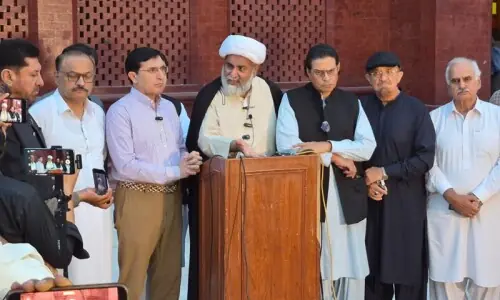
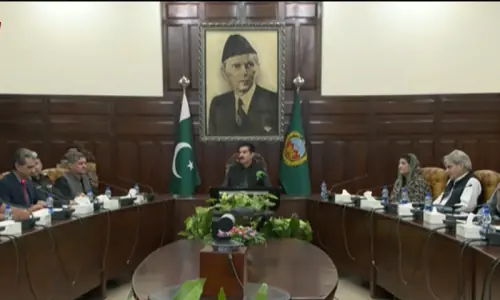
MUZAFFARABAD: A high-level national conference on Thursday reaffirmed Pakistan’s unwavering commitment to regional peace, strategic stability, and the right to self-determination for the Kashmiri people, while also highlighting India’s militaristic ambitions, cross-border provocations, and systematic oppression of minorities.
Held to mark the sixth anniversary of Operation Swift Retort—Pakistan’s decisive response to Indian aggression on February 27, 2019—the conference underscored how the operation shattered India’s claims of conventional superiority, reinforced Pakistan’s deterrence posture, and showcased the nation’s resolve to counter any misadventure.
Speakers also criticised India’s use of misinformation to distort the Kashmir cause and called for proactive resistance against its hegemonic designs.
Titled ”27th February: An Affirmation of Pakistan’s Resolve on the Kashmir Conflict, Peace, and Stability,” the conference was organised by the Centre for International and Strategic Studies (CISS) at the University of Azad Jammu and Kashmir (UAJK).
AJK’s Acting President Chaudhry Latif Akbar was the chief guest.
The event attracted a diverse audience, including students, academics, policymakers, politicians, and bureaucrats.
In his keynote address, Acting President Akbar recalled the events of February 27, 2019, and said that Pakistan’s response had shattered India’s claims of conventional military superiority.
He commended Pakistan’s steadfast support for the Kashmiri people, noting that Kashmiris, in turn, stood unwaveringly with Pakistan.
“Ironically, the economic interests of global capitalism have overshadowed the suffering of Kashmiris and Palestinians,” Mr Akbar regretted.
Highlighting the sequence of events leading to Operation Swift Retort, Parliamentary Kashmir Committee Chairman Rana Qasim Noon reaffirmed Pakistan’s unwavering commitment to defending its territorial integrity and supporting Kashmiris in their struggle for self-determination.
Addressing the conference, Mr Ramesh Singh Arora, a Pakistani Sikh leader, described India as the epicentre of cross-border terrorism and highlighted the systemic oppression of minorities in the country.
Reflecting on the events of February 27, 2019, he termed it a pivotal moment, proving Pakistan’s military preparedness against Indian aggression.
Analysing India’s foreign policy through the ‘Kautilyan strategic lens’, Maj-Gen (R) Syed Shahab Shahid argued that India’s engagement in cross-border terrorism, from Pakistan to Canada, was rooted in this framework.
He warned that India was actively developing pre-emptive military capabilities, which threatened regional strategic balance.
Referring to Pakistan’s response on February 27, he noted that the “Quid Pro Quo Plus” policy ensured the neutralization of Indian aggression under the ‘Full Spectrum Deterrence’ framework.
Speaking on India’s reluctance for meaningful dialogue and its orchestration of false flag operations, Lt-Gen (R) Sarfraz Sattar pointed out that misinformation campaigns had significantly undermined the Kashmir cause.
“This situation demands a proactive resistance at every level rather than appeasement,” he asserted.
“Pakistan must remain resolute in its pursuit of Kashmir’s freedom, as moral righteousness ultimately prevails.”
Earlier, in her introductory remarks, Dr Khawaja examined contemporary geopolitical shifts, referencing fractures within the transatlantic alliance, the rise of Donald Trump, and the emergence of Artificial Intelligence (AI) in global affairs.
She regretted that global powers disproportionately favoured India while restricting Pakistan’s access to critical defence technologies.
Of February 27, 2019, she said: “Tactical superiority and operational excellence outweigh mere numerical strength in warfare.”
Published in Dawn, February 28th, 2025