More than 1,000 Syrians died in airport prison under Assad: report


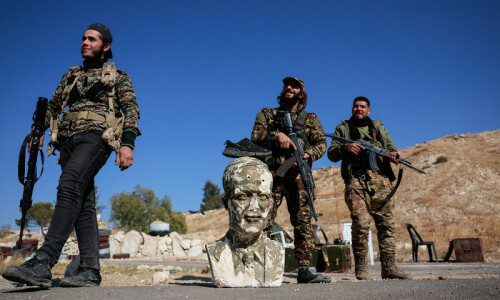
More than 1,000 Syrians died in detention at a military airport on the outskirts of Damascus, killed by execution, torture or maltreatment at a site that was widely feared, according to a report to be published on Thursday tracing the deaths to seven suspected grave sites.
In the report, shared exclusively with Reuters, the Syria Justice and Accountability Centre said it identified the grave sites by using a combination of witness testimony, satellite imagery and documents photographed at the military airport in the Damascus suburb of Mezzeh after the ouster of President Bashar al-Assad in December.
Some sites were on the airport grounds. Others were across Damascus.
Reuters did not examine the documents and was unable to independently confirm the existence of the mass graves through its own review of satellite imagery. But Reuters reporters did see signs of disturbed earth in images of many of the places pinpointed by SJAC.
Two of the sites, one on the Mezzeh airport property and another at a cemetery in Najha, show clear signs of long trenches dug during periods consistent with witness testimony from SJAC.

Shadi Haroun, one of the report’s authors, said he was among the captives. Held over several months in 2011-2012 for organising protests, he described daily interrogations with physical and psychological torture intended to force him into baseless confessions.
Death came in many forms, he told Reuters.
Although detainees saw nothing except their cell walls or the interrogation room, they could hear “occasional shootings, shot by shot, every couple of days”.
Then there were the injuries inflicted by their tormentors.
“A small wound on the foot of one of the detainees, caused by a whipping he received during torture, was left unsterilised or untreated for days, which gradually turned into gangrene and his condition worsened until it reached the point of amputation of the entire foot,” Haroun said, describing a cellmate’s plight.
In addition to obtaining the documents, SJAC and the Association for the Detained and Missing Persons in Sednaya Prison interviewed 156 survivors and eight former members of air force intelligence, Syria’s security service that was tasked with the surveillance, imprisonment and killing of regime critics.
The new government has issued a decree forbidding former regime officials from speaking publicly and none were available to comment.
“Although some of the graves mentioned in the report had not been discovered before, the discovery itself does not surprise us, as we know that there are more than 100,000 missing persons in Assad’s prisons who did not come out during the days of liberation in early December,” said a colonel in the new government’s Interior Ministry who identified himself by his military alias, Abu Baker.
“Discovering the fates of those missing persons and searching for more graves is one of the greatest legacies left by the Assad regime,” he said.
Hundreds of thousands of Syrians are estimated to have been killed since 2011 when Assad’s crackdown on protests spiralled into a full-scale war. Both Assad and his father Hafez, who preceded him as president and died in 2000, have long been accused by rights groups, foreign governments and war crimes prosecutors of widespread extrajudicial killings, including mass executions within the country’s prison system and using chemical weapons against the Syrian people.
The SJAC said all the survivors it interviewed were tortured.
The report focuses on the first years of the uprising, from 2011 to 2017. However, some of the testimonies from former regime officers based at Mezzeh detailed events up to the regime’s fall.
The Mezzeh military airport was an integral part of the Assad government’s machinery of enforced disappearance and housed at least 29,000 detainees between 2011 and 2017, according to the report.
By 2020, according to the report, air force intelligence had converted more than a dozen hangars, dormitories and offices at Mezzeh into prisons.
SJAC, a US-based Syrian-led human rights group funded by European governments and, until the recent funding freeze by the Trump administration, the US government, said its estimate of the dead comes from two air force intelligence datasets listing a total of 1,154 detainees who died there between 2011 and 2017.
The datasets were leaked in a Facebook group monitored by SJAC as the regime collapsed and cross-checked by the organisation against documents and witness testimony. The estimate does not include people who were executed after being sentenced to death by a military field court set up inside a hangar.
According to witness testimony in the report, officers and soldiers were executed by firing squad, while civilians were hanged. Two witnesses said many of those executed were buried near the hangar.
In December, the US Justice Department unsealed war crimes charges against two ranking Syrian air force intelligence officers over “the infliction of cruel and inhuman treatment on detainees under their control, including US citizens, in detention facilities at the Mezzeh Military Airport”.