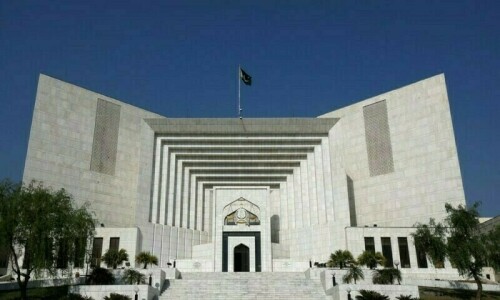
THE Supreme Court faces a crisis of legitimacy. A growing chorus within the legal community has been calling for challenges to the 26th Amendment to be heard by a full court, but the appeal has fallen on deaf ears.
There is increasing frustration over the complications created by the law, especially as it has begun interfering with the independent functioning of the judiciary. The growing public perception is that the judiciary has been hijacked by other branches of the state, with judges being appointed to senior positions not on the basis of individual merit but on what ‘services’ they may be able to offer in return for their appointments.
While it would be unfair to believe such criticisms without supporting evidence, the fact remains that there has been very little effort on the part of the institution and its leadership to address such concerns in good faith.
Recent remarks by one of the senior-most judges of the Islamabad High Court have underlined the fact that criticism of the 26th Amendment is not simply political in nature.
Justice Mohsin Akhtar Kayani, senior puisne judge of the Islamabad High Court, on Tuesday lent his support to the caucus calling for a full court to hear the 26th Amendment challenges. He seemed convinced the amendment was moved in response to a “letter”, ostensibly the one written by six justices of the IHC detailing brazen meddling in court affairs. Many others seem to share very similar views.
Meanwhile, that same day, the constitutional bench of the Supreme Court set aside a ruling issued by a regular bench regarding the administrative jurisdiction of the committees that oversee case assignments.
The decision prompted a recusal from one of the judges of the constitutional bench, who left with a note that the court should “preserve and safeguard the sanctity of judicial orders”.
Clearly, there is much unrest within the superior judiciary over the 26th Amendment and its resultant complications and controversies. There is force in the position taken by many fair-minded individuals within the legal community that the challenges against the amendment must be heard by all justices of the Supreme Court so that they are conclusively decided.
The judges assigned to one bench do not become superior in their legal acumen compared to those assigned to other benches merely by virtue of their appointment. Therefore, there is no reason why only some should decide the challenges and others should not.
There are also several past precedents of a full court hearing challenges to constitutional amendments to support this demand. There is no denying that the integrity and independence of the present Supreme Court seem to be in doubt, even among those within the judiciary. It seems prudent to settle all concerns fairly instead of allowing them to fester.
Published in Dawn, January 30th, 2025