'No delaying tactics will be accepted': JI warns of resuming march to Islamabad if fuel levy not abolished
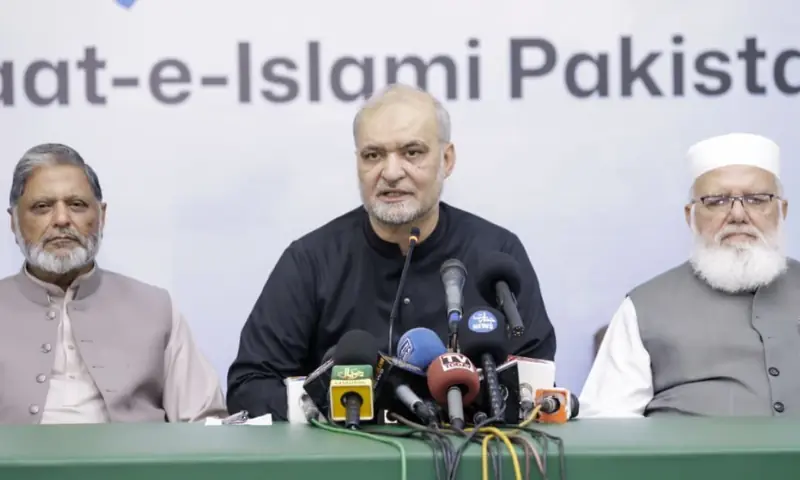
LAHORE: The Jamaat-i-Islami (JI) on Thursday warned that it would resume its long march to Islamabad with greater force if the government failed to abolish the petroleum levy, saying that the party was not bound by any commitment to Prime Minister Shehbaz Sharif.
The government is collecting Rs114 per litre in taxes and duties on petrol and Rs100 per litre on diesel.
The JI had postponed the march, calling for an end to the petroleum levy, just a day after it began on Sept 21 at the PM’s, pending a meeting with him.
The prime minister had left for the United Nations General Assembly session soon after the development and returned earlier this week. But no meeting of him with JI leaders has taken place so far.
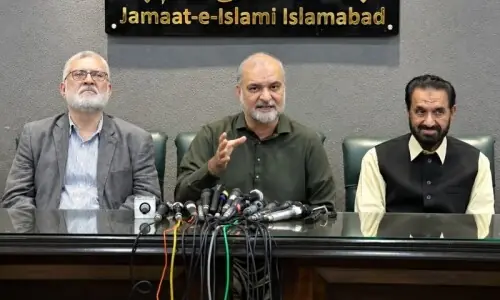
Addressing a press conference at JI’s Mansoorah headquarters in Lahore, party chief Hafiz Naeem ur Rehman said: “The prime minister may or may not talk to us. We are only concerned with relief for the people through the withdrawal of around Rs135 per litre petroleum levy and other taxes.”
Rehman said the JI campaign against the levy would continue and warned that the long march would begin from Multan if the government did not abolish the levy.
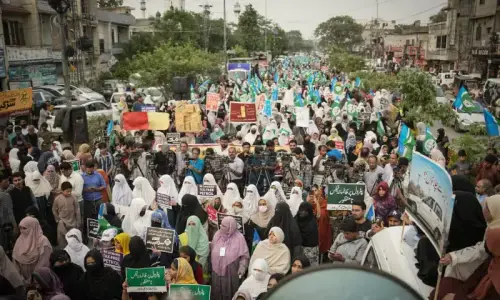
“Caravans from across the country will head towards Islamabad,” he said, adding that public meetings were being held in different cities and a signature campaign was also under way. The JI, he said, would collect more than 20 million signatures against the levy.
“PM Shehbaz Sharif has returned to the country. Let’s see what relief he provides. No delaying tactics will be accepted,” he asserted.
The JI chief rejected the government’s argument that the International Monetary Fund (IMF) programme prevented it from abolishing the levy. He alleged that the government was passing the burden of the Federal Board of Revenue’s inefficiency on to ordinary citizens while giving assurances to the IMF to meet revenue targets.
He also criticised what he described as excessive government spending, questioning the purchase of an aircraft by Punjab Chief Minister Maryam Nawaz and the plan to buy bulletproof vehicles worth billions of rupees for the Shanghai Cooperation Organisation conference next year. He asked what would happen to the vehicles after the conference.
Rehman accused the government of burdening consumers with fuel adjustment charges while paying billions of rupees to independent power producers in capacity payments.
The JI chief also condemned the killing of three Pakistanis by pirates during an operation by Somali security forces. He said the JI had raised its voice at every forum for the release of Pakistani hostages and alleged that the government had failed to play an effective role.
“It is extremely shameful and regrettable that the government did not play its role in this matter,” he said, demanding that the bodies of the deceased Pakistanis be brought back home and financial assistance provided to their families.
On the political situation in Khyber Pakhtunkhwa, Rehman opposed reports of possible governor’s rule or emergency in the province.
He warned that any “unconstitutional action or use of force” would further worsen the situation and alienate the people in the province. He called for dialogue with the PTI, saying that if the government was in a difficult situation, it should opt for negotiations.
“The JI is also ready to play a role in this regard,” he said, claiming that the party was in contact with PTI leaders and recognised their right to peaceful protest.
The party has been staging regular sit-ins in Lahore, Peshawar, Karachi and dozens of other locations across the country since August 16 to protest the levy but has postponed the march to Islamabad.