• Only two members of Constitutional Bench review details of procedure adopted during military trials of May 9 suspects
• Govt counsel says judges ‘can’t keep’, but review the papers
• Judges wonder if military court judges are ‘independent’ or subordinate to their superiors
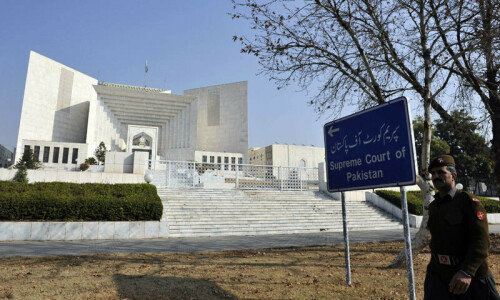
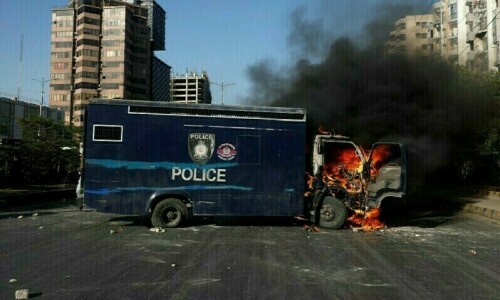
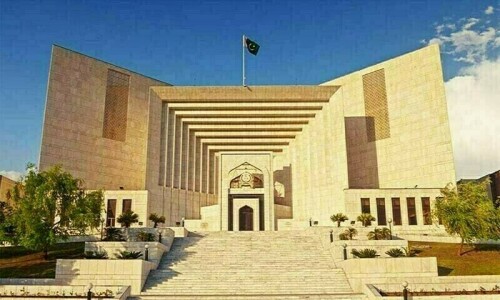
ISLAMABAD: The Constitutional Bench (CB) of the apex court, on Wednesday, returned sealed envelopes submitted by the government counsel, which outlined the procedures followed during the military trial of civilians involved in the May 9, 2023, attacks on military installations.
Though the judges took a cursory look, they returned the envelopes when Justice Jamal Khan Mandokhail suggested that it would not be appropriate to examine the documents, as the matter might reach the high courts and eventually land at the Supreme Court’s door in future appeals.
At this, all members of the seven-judge CB preferred returning the documents, except for Justice Muhammad Ali Mazhar, who expressed his desire to read the procedures for his personal understanding, and returned the documents after going through them.
Justice Musarrat Hilali also asked to read the documents, while Justice Amin-ud-Din Khan endorsed the decision to return them, stating that the case should not be prejudiced.
The seven-judge CB, headed by Justice Khan, had taken up a set of intra-court appeals (ICAs) against the Oct 23, 2023, five-judge bench order nullifying the military court trials of civilians involved in the May 9 violence.
Defence Ministry counsel Khawaja Haris Ahmed, while presenting the documents, argued that the court could read them but not retain them.
He explained that the document detailed the procedures followed during the military trials of the May 9 accused, including how the military court was convened, how the trial commenced, and how the presiding officer, prosecutors, and even the interpreters took an oath before the trial began.
The documents also outlined how the sentence awarded was confirmed by the commanding officer and how witnesses were cross-examined. Furthermore, before the trial commenced, the accused were asked if they had any objections to the presiding officer, but none raised any.
What disturbed Justice Hilali during the hearing was the absence of any procedure for transferring civilian cases from anti-terrorism courts (ATCs) to military courts, especially when the initial charges against the accused were under the PPC. Besides, one of the accused claimed that no eyewitnesses were presented during the trial.
In response, the counsel explained that some cases were transferred to military courts from ATCs, while others came from magistrate courts. He also pointed out that the judge was delving into case details, despite the possibility that the matter might come before them in appeal in the future.
Justice Syed Hasan Azhar Rizvi questioned whether the presiding officers of the military courts were fully experienced or if any officer could conduct the trial.
The counsel replied that experience was not necessary, but the officers had a complete understanding of the Pakistan Army Act (PAA). He said that those conducting military trials did not require special training, as their role was to determine whether the accused were guilty or not. He assured that all safeguards for a transparent trial had been put in place.
At this, Justice Mandokhail expressed regret, stating that “our country has become so trained that two people sit and nullify the decision rendered by eight judges of the Supreme Court”.
The counsel, however, responded that social media should not be a topic of discussion, adding that some individuals on social media forums consider themselves experts on everything. “Let them do their job; we should not be concerned about them.”
Justice Hilali, however, regretted that an unfortunate impression was being created on social media, suggesting that she belonged to a particular political party due to her observations. She clarified that, as a judge from Khyber Pakhtunkhwa, she was simply asking questions about the impact of military trials.
Justice Rizvi observed that a cursory look at the document suggested that the records presented did not pertain to state security, but rather to attacks on military installations.
He questioned why, if the military trials of the accused were conducted in great detail, the proceedings should not be made public to expose those who committed the offenses, allowing the public to condemn them instead of keeping the information under wraps.
The counsel, however, said that this was for the authorities to decide.
Justice Mandokhail emphasised that his only concern was whether the presiding officers conducting the military trials were independent, like judges under Article 175, or subordinate to their respective authorities.
The counsel said if anyone had evidence, they should speak up, as mere perceptions could not be objected to.
However, Justice Mandokhail remarked that while he neither had any doubt nor objection against anyone, but the question remained as to who were conducting the trials in the military courts. “Don’t you trust the civilian courts that offences under the Official Secrets Act (OSA) will always be tried by the military courts?”
The counsel emphasised that military trials under the PAA were never in conflict with fundamental rights and could not be challenged on that basis, as stated in the Constitution. He said military courts have independent identities and operate outside the ambit of Article 175, under which normal courts are established.
Published in Dawn, January 30th, 2025