THOUGH the KP government has hammered out a seemingly comprehensive ‘roadmap’ to bring peace to Kurram district, the barbaric murder and decapitation of two men on Monday on their way to Parachinar underscores the fact that implementing these measures will require the state’s full commitment.
Influenced by decades-old tribal and sectarian rivalries, with the state mostly playing the role of bystander, and complicated by geopolitical factors, the Kurram conundrum will require more than mere statements to resolve. From the looks of it, the KP cabinet’s roadmap seems quite detailed. For example, it envisions a special force to protect the region’s thoroughfares, a deweaponisation drive, as well as measures to punish hatemongers spreading incendiary content online. If implemented in full, these steps could bring peace and healing to Kurram. But it is a very big ‘if’.
The latest round of bloodletting was sparked after a convoy was attacked last month; over 130 lives have been lost in the violence. Moreover, the main road to Peshawar has been blocked for over two months, resulting in severe shortages in Kurram. The most heart-wrenching outcome of this de facto blockade has been the fact that the district faces a shortage of medicine; according to social worker Faisal Edhi, around 50 babies have died due to lack of treatment. This is an unconscionable state of affairs in any civilised society.
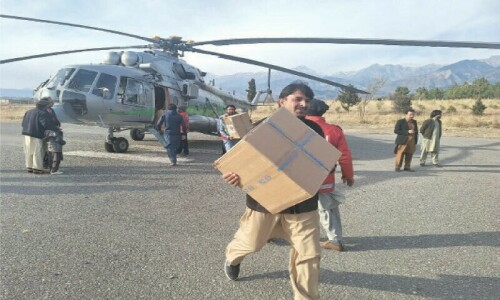
State functionaries insist there is no shortage, and both public and private actors have started ferrying in lifesaving drugs, along with airlifting critical patients to Peshawar. But these are stopgap measures, and only the permanent reopening of Kurram’s thoroughfares — with safety of travellers guaranteed by the state — can end the suffering of the district’s people.
Deweaponisation of the area’s armed groups is also key to bringing peace, as the roadmap has observed. Both the Shia and Sunni communities of Kurram have access to heavy arms, thanks to the presence of militant groups belonging to both sides. Therefore, the state must confiscate heavy weapons across the board to ensure peace. However, some tribes feel that if their arms are taken away, they will become sitting ducks for terrorist groups based just across the border in Afghanistan, as well as local militants.
The state must provide ironclad guarantees that the local population will be protected from all forms of terrorism, and that no militant group will be able to operate in the area. Up till now, successive federal and provincial governments, as well as the security establishment, have been unable to judiciously resolve Kurram’s complex and interwoven conflicts, and guarantee peace to its people.
Hopefully, the fresh roadmap can change things, but only if all pillars of the state are interested in having it fully implemented. The people of Kurram have suffered enough.
Published in Dawn, December 25th, 2024