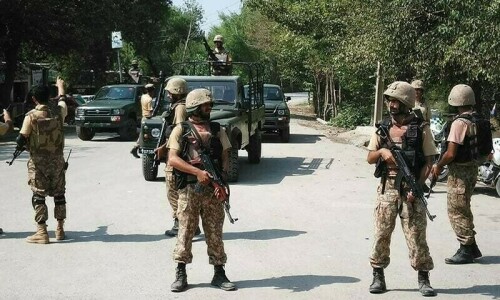
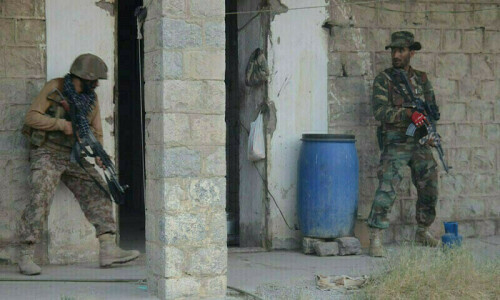
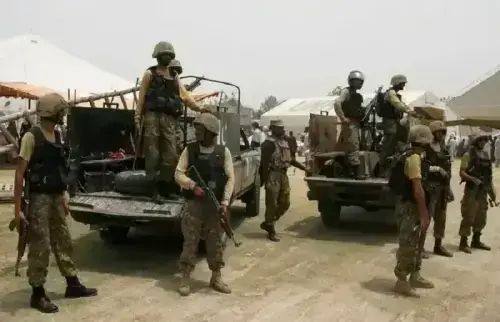
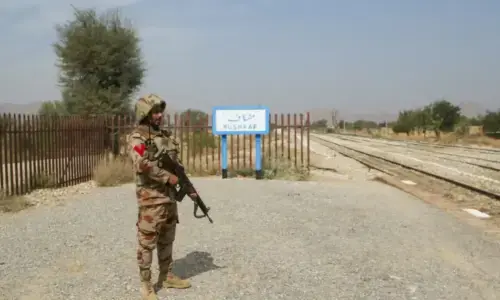
The country lost at least 55 security personnel in the first three weeks of November in a string of clashes and suicide bombings, suggesting a protracted surge in violence across the country.
According to the Pakistan Institute for Conflict and Security Studies (PICSS), a think tank based in Islamabad, 55 security personnel were killed in the first 20 days of November compared to 30 during the same period last month. Sixty-three terrorists were also killed in clashes with security forces in the past 20 days.
In October, security forces lost 62 personnel, marking the highest number of such casualties in any month this year, data from PICSS showed, with 32 killed in the last 10 days of October alone.
Terrorist attacks this month included two suicide bombings: one on November 9 at a railway station in Quetta that killed 28 people, including 14 soldiers, and the other in Khyber Pakhtunkhwa’s Bannu district on November 19, which claimed the lives of 12 soldiers.
Most of the attacks were concentrated in the two provinces.
Pakistan endured 785 terrorist attacks over the past 10 months of 2024, resulting in 951 deaths and 966 injuries, reflecting a persistently high level of violence across the country.
The uptick in violence, according to PICSS, underscored the ongoing security challenges, particularly in KP and Balochistan, as violence remained a major concern despite fluctuations in the frequency of attacks.
Pakistan has seen a surge in violence since the takeover of Afghanistan by the Taliban in August 2021.
Islamabad accuses “Afghanistan-based” terrorists loyal to the banned Tehreek-i-Taliban Pakistan (TTP) group. Kabul denies the presence of TTP terrorists on its soil. The TTP has claimed responsibility for several recent attacks inside Pakistan.
Lt Gen (retired) Talat Masood, an Islamabad-based security analyst, sees a combination of the Afghanistan factor, local terrorist networks and recent changes in the global security situation behind the surge in violence in Pakistan.
Rejecting Kabul’s denial regarding the presence and operations by TTP militants from its soil, Masood said the unprotected porous border between the two countries served as a major advantage for terrorists.
“Pakistan needs to take some serious actions, including the political and economic uplift of the tribal region and Balochistan, to combat the menace of terrorism,” he added.