THE United Nations Human Rights Committee has sent a clear message to the government: it must work to bring the country’s laws in line with international human rights standards.
The committee’s findings, released after its latest review of Pakistan’s compliance with the International Covenant on Civil and Political Rights, paint a distressing picture of the state of human rights in the country.
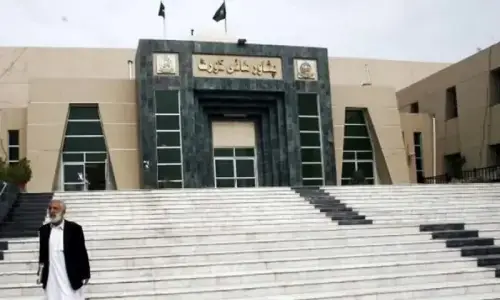
The gravest concerns raised by the committee revolve around the use of military courts to prosecute civilians. This practice not only violates the right to a fair trial, as the committee noted, but also represents a troubling expansion of the establishment’s jurisdiction into the civilian sphere. The committee rightly urged Pakistan to abrogate such jurisdiction over civilians.
The committee’s other findings are equally worrying. It noted the absence of broad, transparent consultations on judicial independence reforms, especially related to the 26th Amendment. Concerns were also raised about the intimidation and harassment of judges and prosecutors, especially in sensitive cases.
The authorities’ ability to access and retain personal data without proper oversight was another observation. Such unchecked surveillance is a serious affront to privacy rights and must be remedied with strong privacy laws, as recommended by the rights body. Furthermore, the committee noted the continued use of enforced disappearances, as well as threats and attacks against journalists and human rights defenders. It has demanded immediate action against such violations.
Another critical area discussed in the review is the death penalty. The committee stressed that although some limitations have been introduced, Pakistan’s continued use of capital punishment, even for non-violent offences requires reconsideration. Its call for a moratorium on executions is especially relevant given concerns about age determination and juvenile justice. The committee also highlighted severe detention conditions and the prevalence of torture, urging Pakistan to take stronger measures to prevent abuse in custody. The rights of children were stressed, with recommendations to end forced conversions and marriages of minority girls.
While the committee acknowledged some positive legislative developments, such as laws addressing gender-based violence and protecting transgender persons, it is clear that much more needs to be done. This cannot be a cosmetic exercise. True reform requires meaningful, transparent consultations with all stakeholders — judges, prosecutors, lawyers, civil society — to ensure the independence and integrity of key institutions.
Pakistan must heed this wake-up call and embark on a concerted effort to bring its laws and practices in line with its international human rights obligations. Failure to do so will not only undermine Pakistan’s global standing, but more importantly, will deprive its citizens of the rights and freedoms they are entitled to under the ICCPR and the country’s own Constitution.
Published in Dawn, November 9th, 2024