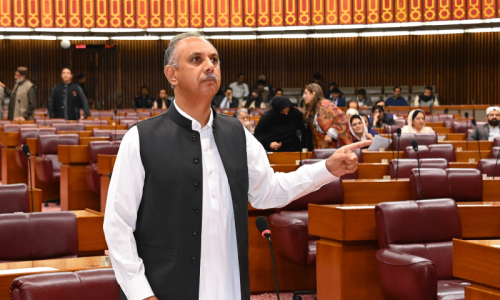
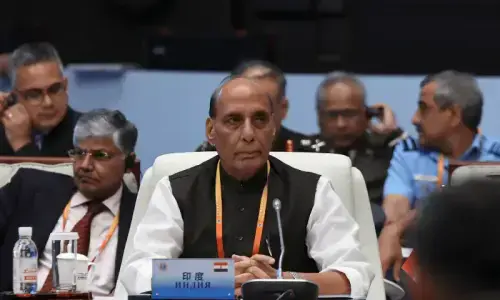
THE law minister and defence minister had noise-blocking headphones snapped on as they rushed through half a dozen pieces of important legislation on Monday evening.
It was a fitting metaphor for the manner in which the ruling parties have lately gone about conducting legislative business. Six bills were introduced in and passed by the National Assembly and Senate in record time to extend the tenure of the armed forces chiefs to five years, with the possibility of another five-year extension, and to increase the number of judges in the Islamabad High Court and Supreme Court.
It seems pointless to ask why the government saw it appropriate to bulldoze these bills: for all its stress on ‘supremacy of parliament’, the ruling coalition has, thus far, wasted no opportunity to reiterate where its allegiances truly lie. Perhaps if the opposition had been allowed to have its say, some respect for the legislature may have been salvaged.
The decision to extend the military chiefs’ service tenure as well as the tenure of their extensions to five years came as a surprise. Though government representatives were later at great pains to explain, on national media, how wonderful the decision was for Pakistan as it would put to rest the frequent intrigues that chase the appointment of an army chief, one wonders why they did not say so in parliament when the legislation was tabled.
Indeed, the speed with which all legislative business was concluded — in 24 minutes in the National Assembly and 16 minutes in the Senate — suggested that the justifications may have been an afterthought. A five-year tenure for services chiefs may indeed create some positive externalities — especially in terms of stability and continuity of policy within the armed forces — but it is difficult to understand why service extensions, which are, in any case, supposed to be granted in special circumstances only, also needed to be extended for the length of another full tenure.
Lastly, it defies understanding why the government now wants to pack so many more judges into the higher courts, especially after the superior judiciary has been rendered nearly toothless after the 26th Amendment. It is a documented fact that the backlog of court cases, often cited by this government as the reason for its repeated interference in the judicial structure, is disproportionately higher at the lower levels of the judiciary.
Yet, no legislation has been brought to remedy this dysfunction, while the powers of superior courts continue to be diluted on the pretext. Indeed, the government’s legislative agenda has so far seemed focused less on ‘actual problems’ and more on ‘our problems’. When this will change, is anybody’s guess. One hopes our lawmakers are now feeling more secure in their positions, and a redirection of priorities will come soon.
Published in Dawn, November 6th, 2024