TO say that Punjab is Pakistan’s heartland is to state a simple fact. Even if one were to separate the Seraiki belt from the administrative unit that is the province, Punjabis are still the country’s single biggest ethnic-linguistic group. Punjab retains control over the single largest share of economic resources and is the most politically powerful province.
Punjab has long been the crucial cog that has sustained military hegemony. Not only has a majority of the military rank-and-file and top brass been recruited from Punjab, but barring exceptional historical moments, a critical mass of Punjab’s people has provided consent to the national security state.
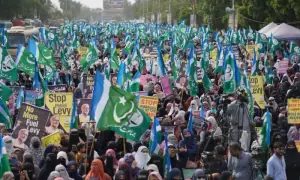
Is this consensus now fracturing? The political tug-of-war between the establishment and the PTI has certainly been accompanied by a greater and far more vocal critique of the former’s role in Pakistan from within Punjabi society than at any time in the recent past, especially amongst younger generations. Interrogating this contradiction is important not just to gauge what the future may hold for the PTI but for Pakistan’s historic militarised structure of power generally.
Elite wrangling or popular challenge: A notable feature of the current political imbroglio is fragmentation of Punjab’s political elite. Urbane DHA dwellers hailing from army families and dynasties like the Chaudhrys of Gujrat are positioned against the current top brass. Meanwhile, somewhat autonomously of the ruling-class rebels, working-class Punjabi youth have flocked to the PTI’s cause, united in their adulation for Imran Khan and as vociferous in their anti-establishment rhetoric.
The core-periphery divide must be addressed.
If palace intrigues take yet another turn and Punjab’s ruling-class rebels currently on the outside of the power equation are let back in, will anti-establishment sentiment amongst young, working people also dissipate? There are no guarantees in politics, and the answer will be determined by other related questions.
Economic factor: It is generally understated that the anti-establishment vote cast by many young people on Feb 8 was as much about the economy as anything else. The selective but successful argument peddled by the PTI was that inflation, unemployment and economic hardship were largely absent during Imran Khan’s reign and that the establishment committed a grave sin by booting out the PTI government and bringing back the Sharifs and Bhuttos.
What is missing in this story is that the establishment’s power is not just based on its manipulation of mainstream political parties, but also on an historic economic arrangement that would have to be undone if things are truly to change in this country. This establishment-centric economic order includes ever-inelastic budgetary allocations to defence, huge hidden subsidies provided to business entities like the NLC and FWO as well as the establishment’s broader footprint in natural resource grabs and profitable sectors such as real estate. Only when Punjab’s disaffected working-class youth get behind a substantive project to displace the bloated national security apparatus with a welfare-oriented political economy, and redistribute wealth away from the militarised ruling class as a whole, will we see the crystallisation of a substantive anti-establishment politics in Punjab.
The national question: The final piece of this puzzle has to do with Punjab’s relationship with the rest of Pakistan’s ethnic nations. Establishment hegemony has been based on a dominant ideology that has privileged Islam and Urdu whilst criminalising national assertion by Bengali, Baloch, Pakhtun, Sindhi and other ethnic groups. Alongside que-stions of identity, the oppression of non-Punjabi peripheries has pivoted on the allocation of economic resources and control over the state apparatus.
At a time when movements like the PTM and BYC are subject to intense state repression, effectively repeating the cycle of history that started with the contentious accession of Kalat state, jailing of Bacha Khan and more, the question is whether Punjab’s youthful masses are willing and able to extend their fledgling anti-establishment sentiment to the ethnic peripheries and align themselves with the broader demand to end a colonial social contract and start afresh. This may be the hardest sell of all, but if there is a future to Pakistani politics beyond palace intrigues, the core-periphery divide must be addressed, not least of all because ecological crises bind all geographical regions together whether we like it or not.
Punjab has never been a monolith. Anti-establishment politics has always survived in Pakistan’s heartland despite military hegemony. As this hegemony frays, Punjab’s working people hold the key to how our putatively collective future unfolds.
The writer teaches at Quaid-i-Azam University, Islamabad.
Published in Dawn, October 11th, 2024