ISLAMABAD: Adviser to Khyber Pakhtunkhwa Chief Minister on Finance Muzammil Aslam has stressed the need for enhancing the capacity of provincial Bureau of Statistics and leveraging data and digitalisation to improve service delivery.
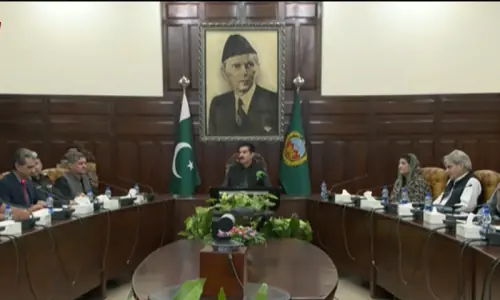
He was addressing the inaugural meeting of Sustainable Development Policy Institute (SDPI)-led National Network of Economic Thinktanks (NNETT) Advisory Committee for Khyber Pakhtunkhwa chapter.
Highlighting KP’s goals of increasing tax and non-tax revenue, Mr Aslam reiterated the commitment of the economic team to bolster provincial resources, particularly towards the education and health sectors.
He stressed the importance of that inclusive network as a government watchdog and an accountability mechanism at local level. He also highlighted the government’s focus on public-private partnership-based solutions to support the sector.
Making KP an attractive investment destination through inclusive economic policies was also a key focus of his address. Former provincial minister for revenue Adnan Jalil echoed Mr Aslam’s sentiments, advocating for the digitalisation of government departments to standardise operations.
The provincial chief of Small and Medium Enterprise Development Authority (Smeda), Rashid Aman, called for future policy research to align with the International Monetary Fund (IMF) package, supplemented by comprehensive impact assessments at both federal and provincial levels.
He stressed the need for evaluating the impact of 18th Amendment and development of district level profiles and value chains linked to global networks.
He talked about the significance of academia-industry linkages and referred to successful collaborations between University of Swabi and Swabi Chamber of Commerce and Industry. He highlighted the need for industry mentorship in incubation centres to enhance outcomes.
The managing director of KP Information Technology Board (KPITB), Dr Akif Khan, detailed focus areas of the board including digital governance, IT industry ecosystem development, export and digital literacy. He talked about ongoing initiatives such as training in gaming and artificial intelligence, a forthcoming digital payment and fin-tech strategy and launch of KP open data portal.
The project director of National Incubation Centre, Asim Ishaq, stressed the high potential of information technology sector, advocating for regulatory reforms to support export-oriented businesses, improved digital infrastructure and enhanced digital literacy. He emphasised the importance of integrating digital solutions into other economic sectors to reduce waste.
The representative of e Women Chamber of Commerce and Industry, Peshawar division, highlighted the challenges faced by women entrepreneurs, noting a 60 per cent decline in formal women-led businesses over the past four years due to regulatory hurdles.
Published in Dawn, September 20th, 2024